(Even If You’re Not There Yet)
Your future is not waiting for perfect conditions. It’s waiting for the person you’re choosing to become.
Read that again. Slowly.
Because most of us treat the future like a place. Somewhere out there, past the next promotion, the next sale, the next time load-shedding stops messing with our schedule. But the future isn’t a place. It’s a person. Specifically—it’s you, rebuilt.
And the person you are right now, reading this on your phone, in a taxi, on a lunch break, or in bed at 11pm scrolling instead of sleeping—that person is either closing the gap to who you need to become or widening it. There’s no neutral. Every day does one or the other.
This is the last chapter of the series we’ve been building together for the past twelve weeks. So before we go anywhere new, I want to open with something different. A letter. From your future self to you, right now.
A Letter From Who You’re Becoming
Hey. It’s you. A year from now.
I’m writing this from the other side of the version of you reading this sentence. And I need you to know something before we go further: I didn’t get here by feeling ready. I got here by showing up on the Tuesdays nobody was watching.
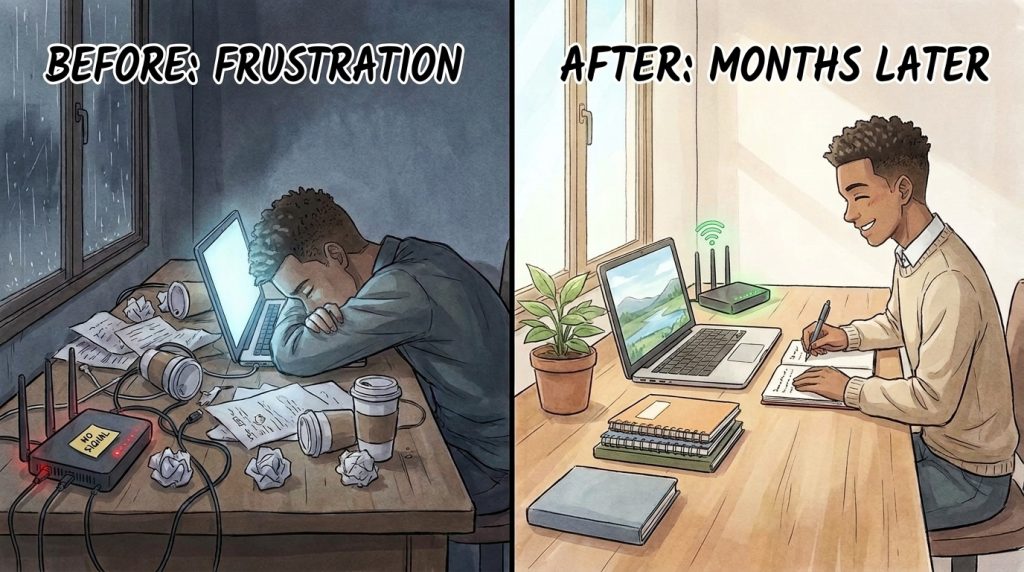
I remember the WiFi cutting out mid-task and you wanting to throw the router out the window. I remember you staring at a blank page, knowing exactly what you wanted to say and not having the words for it. I remember the nights you typed a prompt into an AI tool four times because the first three didn’t sound like you.
None of that was wasted. Every one of those small, unglamorous frustrations is the reason I exist. You didn’t need a miracle. You needed twelve weeks of choosing, again and again, to close the gap instead of complaining about it.
I’m proud of you. Not because it’s finished—it isn’t. But because you’ve rebuilt enough to keep going.
— You later.
Twelve Weeks Later: What Actually Happened
Let’s talk about what this journey really looked like. Not the highlight reel. The actual Tuesday-afternoon version.
I bought my domain—lifecoachinganimated.com—and let it sit dormant for a year. A year. The idea was there. The framework was there. What wasn’t there yet was the version of me who could execute it consistently.
This year, that changed. I started building the blog for real, and the first thing I published was the Identity Reinforcement Loop series—the same framework you’ve been reading for twelve weeks. Here’s the part I didn’t expect: writing it started fixing me before it reached anyone else.
Every post in that series called out something I was still struggling with. Missed deadlines. Blog posts that sat half-written. Social media posts I planned and never posted. I was writing the cure for my own disease and hoping nobody would notice I hadn’t taken the medicine yet.
So I started reading my own blog back to myself. And that’s when the shortcomings became impossible to ignore—because I’d already named them, in public, in my own words. There’s a strange kind of accountability in that. You can’t un-know what you’ve already taught.
The challenges were real, and they weren’t dramatic—they were just persistent:
- Internet connectivity that dropped at the worst possible moment
- Research that took longer than the actual writing
- Sitting with a thought I could feel but couldn’t yet say clearly
- Learning to use AI tools well enough that they helped instead of flattening my voice—writing prompts that actually understood my challenges as a founder, not generic ones
None of these are the kind of obstacle that makes a good movie scene. They’re the kind that makes you quit quietly, one skipped week at a time. That’s exactly why they matter. The boring season doesn’t announce itself. It just tests whether you’ll keep showing up when there’s no applause.
And here’s what showing up built:
- My social media accounts started growing—not overnight, but steadily, post after post
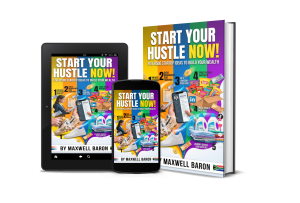
- I built a lead magnet to help South African youth start a hustle with as little as R500
- I ran a full Youth Month series across social media, speaking directly to the audience this brand exists for
None of that happened because I finally felt ready. It happened because I closed the gap one uncomfortable, inconsistent-turned-consistent week at a time. If you’ve been struggling with the same things—deadlines, discipline, doubting whether your voice is worth showing up with—I’m not telling you this from a stage. I’m telling you from the same seat you’re sitting in.
The Future Self Gap: Why You Feel Behind
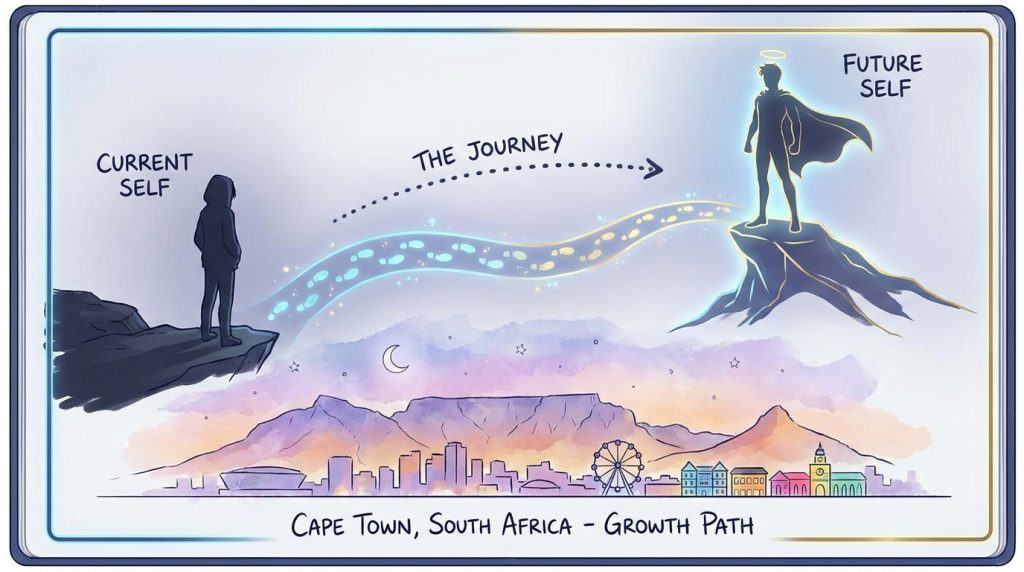
Here’s the framework underneath everything you just read.
The future self gap is the distance between who you are today and who you need to become to have the life, business, or income you say you want. Every entrepreneur has one. The gap itself isn’t the problem.
The problem is what most people do with it: they either deny it exists, or they let it convince them they’re too far behind to start closing it.
Future self-visualization for entrepreneurs isn’t a soft mindset trick you do instead of the work. It’s a targeting tool. You can’t close a gap you haven’t clearly seen. Visualization for business success works because your brain doesn’t fully distinguish between a vividly imagined future and a remembered past—it starts building neural evidence for the version of you that hasn’t happened yet.
That’s the entrepreneurial mindset visualization most people skip, because it feels indulgent compared to “real work”, like a to-do list. But a to-do list without a clear future self behind it is just motion. The future self mindset for entrepreneurs gives that motion a direction.
| Old Approach | Future Self Approach |
| Set a goal, chase it with willpower | Build an identity; let the goal follow naturally. |
| Motivation-dependent—works until you’re tired | Evidence-dependent—works because you’ve proven it to yourself |
| Measures success only by outcome | Measures success by who you had to become |
| Collapses under a bad week | Absorbs a bad week as one data point, not a verdict |
What Is Future Self-Visualization, and How Does It Work for Entrepreneurs?
It’s the practice of building a specific, sensory, detailed picture of who you are once the gap is closed — not the vague “successful business owner” version, but the version who wakes up at a certain time, handles a difficult client a certain way, and speaks about money a certain way. For entrepreneurs specifically, it works because business decisions are identity decisions in disguise. You price, negotiate, and show up the way the person in your head believes they’re allowed to.
How Can Future Self-Visualization Help Me Grow My Business Faster?
It removes decision fatigue. When you’re not sure what a business vision visualization is truly for, every decision becomes a fresh debate. When your future self is clear, most decisions become simple: would that version do this, or not?
What’s the Difference Between Future Self-Visualization and Normal Goal-Setting?
Goal-setting asks, “What do I want to achieve?” Future self-planning for entrepreneurs asks, “Who do I need to become to achieve it sustainably, without burning out or faking it?” One is a finish line. The other is a person you’re building toward that finish line.
How Often Should Entrepreneurs Practice Future Self-Visualization?
Daily, briefly, beats weekly and lengthy. Two to five focused minutes each morning outperforms a single dramatic session once a month, because identity is reinforced through repetition, not intensity.
What Is the Best Time of Day to Do Future Self-Visualization for Business Goals?
Right after waking, before your phone gets involved. Your mind is least defended then, and whatever you feed it first tends to set the emotional tone for how you show up the rest of the day.
Can Future Self-Visualization Really Improve Decision-Making and Confidence?
Yes—because confidence isn’t a feeling you wait for. It’s evidence you’ve collected. Success visualization for entrepreneurs builds a mental rehearsal of handling hard situations well, so when the real version shows up, it’s familiar territory instead of a blindside.
How Do I Create a Future Self-Visualisation Routine That Fits a Busy Schedule?
Attach it to something you already do daily—brushing your teeth, your first commute, boiling the kettle. Two minutes, same trigger, every day. Consistency beats duration every time.
What Are the Best Prompts or Scripts for Entrepreneur-Focused Future Self-Visualization?
Ask yourself: how does this version handle a difficult client email? What does their morning actually look like, hour by hour? How do they talk about money, out loud, to someone else? Specific questions produce specific pictures — and specific pictures are what actually reinforce identity.
Should I Combine Future Self-Visualization With Journaling, Vision Boards, or Affirmations?
Yes, and it works better combined than alone. Visualization builds the picture. Journaling builds the evidence trail. Vision boards keep it visible when motivation dips. Together they cover the emotional, written, and visual channels your brain uses to store identity.
What Mistakes Do Entrepreneurs Make When Trying Future Self-Visualisation?
Making the picture too vague (“successful”), doing it once and expecting permanent change, and skipping it the moment life gets busy—which is exactly when it matters most.
How Can I Use Future Self-Visualization to Overcome Fear of Failure or Imposter Syndrome?
By rehearsing the version of you who has already survived the failure you’re afraid of and kept building anyway. Fear shrinks when you’ve already mentally lived through the worst-case version and watched yourself continue.
Is Future Self-Visualization Compatible With Data-Driven Planning and Strategy?
Completely. Your future self still needs a spreadsheet. Visualization decides who you’re becoming. Strategy decides how that person gets there. You need both—one without the other is either a fantasy or a plan with no fuel behind it.
The Move: Write the Letter Yourself

Everything above is theory until you do this one thing.
Take fifteen minutes. Phone away, or on airplane mode if it has to be nearby. Write a letter from your future self — one year from now—to you today.
Use these prompts to get specific, not vague:
- What does a normal Tuesday look like for future you—from waking up to closing your laptop?
- What’s one hard thing the future you handled well that the current you is avoiding right now?
- What did the future you have to stop doing to become this version?
- What’s one sentence future you would say to yourself, right now, about the thing you keep putting off?
Don’t write what sounds impressive. Write what sounds specific. “I run a successful business” tells your brain nothing. “I close my laptop at 6pm because I trust the work I did today was enough” gives it something to build toward.
Keep the letter. Read it back in a month. You’ll be shocked at how much of it you’ve already started living into.
What “Rebuilt” Actually Means
Here’s the truth nobody puts on the poster.
Rebuilt doesn’t mean perfect. It doesn’t mean the WiFi never drops again, or the words always come easily, or you never miss a post. I’m not writing this from the other side of struggle. I’m writing it from inside a version of the struggle that’s finally moving in one direction instead of in circles.
‘Rebuilt’ means intentional. It means the gap between who you are and who you’re becoming is closing on purpose, not by accident, and not by waiting for a mood to strike. It means you’ve stopped needing to feel ready before you start, because you’ve already proven to yourself—through twelve weeks of showing up—that readiness was never the requirement. Consistency was.
If you’ve been reading this series and seeing your own struggles reflected at you the way I saw mine, that wasn’t an accident either. I built this series to work on me first. I trust it did the same for you. If any part of the last twelve weeks helped you close even a small piece of your own gap, it did exactly what it was built to do.
Your Next Move

You don’t close the future self gap by reading about it. You close it by writing the letter, then living one Tuesday at a time like the person who wrote it.
Two ways to keep going from here:
- Join the WhatsApp channel and share your future self letter. I read them. This is where the next chapter of the conversation happens—outside the comments section, in a space built for people actually doing the work.
- If you’re ready to turn this identity work into an actual income stream, Skill to Scale is the structured next step—built on the same Identity Reinforcement Loop framework, designed for exactly the gap this post just walked you through.
- Rebuilt isn’t a finish line. It’s a direction. Keep facing it.
Resources to Support Your Future Self-Practice
| Resource | Why It Helps |
| The Miracle Journal | Guided prompts for goals, gratitude, and visualisation to clarify your future self and business vision |
| Bold Tuesday Manifestation Journal (52-Week) | Long-term habit tracker and vision board tool for ongoing future self and business planning |
| Future Self Workbook (Digital Download) | Printable exercises and action plans built specifically around future-self work |
| Notion (Vision Board / Goal Templates) | A flexible space to build a digital dashboard for your future self and business goals |
| Canva | Design tool for building vision boards and future-self visuals for your phone lock screen or socials |
Rebuild the Person Who Can Build the Future Series:
- You Can’t Build a New Future With an Old Version of Yourself
- How Self-Perception Shapes Success More Than Talent
- Your Feelings Are Real. But They Don’t Get to Be in Charge
- Mindset Shift Consistency: The Boring Season
- You Need to Trust Yourself First — Here’s How to Earn It
- You’re Just Building the Version That Will Actually
- How to Use Your Gifts to Serve Others: A Practical Guide.
- You Are the Average of Your Environment, Not Just Your Friends
- Falling Down Is Not the Problem. Staying Down Is
- How to Close the Gap to Your Future Self—You Are Here