You can have perfect habits, and the wrong environment will slowly undo all of them.
I used to think discipline was the whole story. Wake up early. Write the plan. Say the affirmation in the mirror. And for a while, it worked — until it didn’t, and I couldn’t figure out why.
Here’s what actually happened. I was sharing a room with two cousins who slept at 2am every night. The Wi-Fi router sat in the lounge, so “just checking one notification” turned into an hour of scrolling because that’s where everyone else was anyway. My phone’s data ran out by the 20th of the month, so my “learning time” became whatever YouTube Shorts loaded for free on Facebook’s app. None of that was a friendship problem. Not one of those cousins ever told me to give up. My environment did the sabotaging, quietly, every single day, without saying a word.
That’s the part nobody warns you about. You can cut off every “bad influence” in your contact list and still lose, because the room you sleep in, the group chats you’re in, and the app that opens by default are all doing damage long before a person even gets involved.
Why “Surround Yourself With Like-Minded People” Is Only Half the Advice
You’ve heard it a thousand times: surround yourself with like-minded people. It’s true. But it’s usually said like your environment is just a guest list: invite the right humans and uninvite the wrong ones. Done! That’s not how it works.
What does “surround yourself with like-minded people” actually mean? It means deliberately positioning yourself near people who share your goals, values, or direction — not people who simply agree with you, and not people who happen to be nearby because of geography or history. It’s a design choice, not a vibe.
Why is it important to surround yourself with like-minded people? Because your standard for “normal” gets set by whoever you’re closest to. If the people around you treat 11pm scrolling as normal, staying up till 2am stops feeling like a decision. It just feels like Tuesday.
How do like-minded people influence your mindset? Through repetition, not persuasion. Nobody sits you down and convinces you to lower your standards. You absorb what’s around you, the same way you pick up an accent from the city you live in.
But people are only one layer. There are three more layers working on you at the same time, and most self-help content skips straight past them.
The 4-Layer Environment Model
Think of your environment as four layers stacked on top of each other. Change one and ignore the rest, and the other three will quietly cancel out your progress.
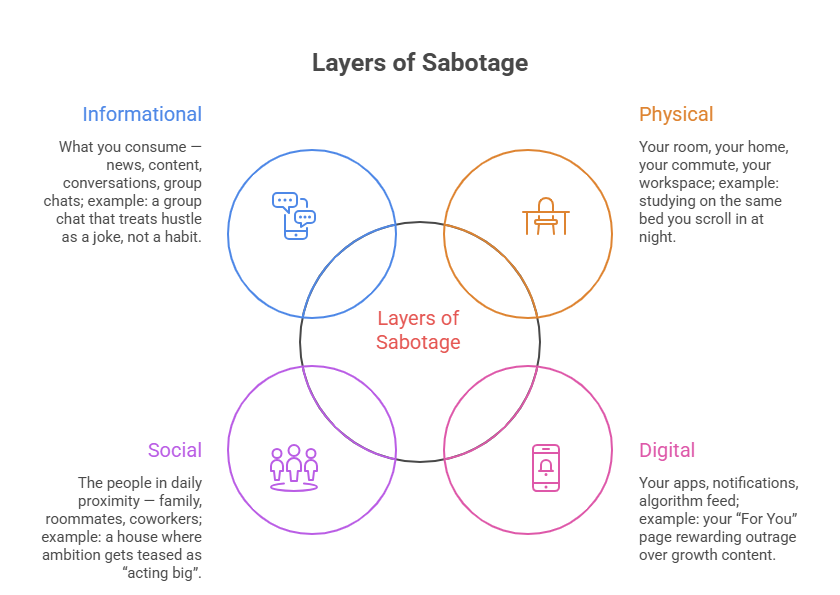
Here’s the trap. Most people only fix the social layer. They find one accountability partner, post about “cutting off negative energy”, and assume they’re done. Meanwhile, the physical layer still has them studying in bed. The digital layer is still feeding them fifteen-second dopamine hits between tasks. The informational layer is still filling their head with noise that has nothing to do with where they’re trying to go.
Real change happens when all four layers point in the same direction, even slightly. Not perfectly. Slightly.
The South African Layer Nobody Talks About
Most “change your environment” advice comes from somewhere with a spare bedroom and unlimited fibre. That’s not most of us.
If you’re sharing a room, a flat, or a whole house with family, you don’t get to just “remove toxic people” the way a podcast tells you to. Your mother is still your mother. Your cousin still needs a place to stay. Environment design here isn’t about cutting people off — it’s about protecting pockets of space and time inside a shared reality.
That looks like:
Physical layer, SA style: You might not get your own room, but you can claim a corner, a specific chair, or a specific hour — a spot that your brain learns to associate with focus, even inside a shared house.
Digital layer, SA style: Data costs money here. That changes the whole equation. Downloading a course on Wi-Fi at work or at a friend’s place, then studying it offline, protects your growth from your data running out on the 20th.
Social layer, SA style: The block you grew up on, the taxi rank you pass through, the family gathering on a Sunday — these aren’t optional extras you can mute. The move isn’t an escape. It’s building pockets of like-minded contact inside a world you’re not leaving.
Informational layer, SA style: Load-shedding schedules dictate more than lights. They dictate when your phone charges, when the Wi-Fi is on, and when you can actually consume anything at all. Planning your input around the schedule, instead of around wishful thinking, is environment design too.
Ubuntu says a person is a person through other people. That cuts both ways. The people around you can build you up or slowly wear you down, and in a shared house, you often can’t choose who’s in the room. What you can choose is what corner of that room belongs to your growth.
Where Do You Actually Meet Like-Minded People?
Where can I meet like-minded people? Start smaller than you think. A community WhatsApp group built around a specific goal beats a generic networking event nine times out of ten, because shared intent already exists before you say a word.
How do I find people who share my goals? Look for rooms — online or offline — that are organised around an outcome, not a personality type. A study group. A savings stokvel. A fitness group that meets before work. Shared action reveals shared values faster than shared opinions do.
Are networking events useful for finding like-minded people? Sometimes, but they’re often overrated for people early in a goal because the room is full of strangers performing confidence. A smaller, recurring group — even three people — usually builds more real support than a one-off event with three hundred.
Can a mentor be considered a like-minded person? Yes, and often a better one. A mentor is someone already living slightly ahead of where you’re trying to go. They don’t need to be your age or your background. They need to be proof that the direction you’re choosing actually leads somewhere.
How can I build meaningful relationships with like-minded people online? Show up consistently in the same digital spaces — comment before you post, engage before you ask for anything, and let the relationship build across weeks, not one message.
How can I attract like-minded people? By being visibly consistent in the direction you claim to want. People notice patterns before they notice announcements.
Like-Minded Doesn’t Mean “Agrees With Everything I Say”
This is where a lot of people quietly get it wrong.
What is the difference between like-minded people and people who agree with everything I say? Like-minded people share your direction. Yes, people share your mood. One challenges your excuses because they respect your goal. The other tells you what keeps the peace.
Should I avoid people who have different opinions? No. A different opinion, held respectfully, sharpens you. What you’re avoiding isn’t disagreement — it’s people whose daily habits actively pull against the person you’re trying to become.
How do I know whether a community is genuinely supportive? Genuine support has friction in it. A supportive community will ask, “Have you actually done the thing?” not just, “How are you feeling about the thing?” Comfort-only spaces feel great and change nothing.
What If Your Current Friends Don’t Support Your Goals?
What should I do if my current friends do not support my goals? You don’t need a dramatic cutoff scene. Most of the time, the honest move is quieter: you simply stop making them the main audience for your goals, and you start building a second circle — even a small one — around the direction you’re actually going. Old friendships can stay. They stop being your only environment.
How Many Like-Minded People Do You Actually Need?
How many like-minded people should I have in my circle? Fewer than you think. Two or three people who take your goal seriously will outperform a hundred followers who only take your highlight reel seriously. Depth beats headcount here, every time.
Can surrounding yourself with like-minded people improve success? Yes — not through magic, but through consistency. Reminders repeat, standards get reinforced, and the boring, unglamorous work of showing up again becomes normal instead of exceptional.
The Environment Audit: Your Practical Move
Reading about four layers doesn’t change anything. Auditing your actual environment does. Take fifteen minutes and run this across all four layers — physical, digital, social, and informational.
For each layer, sort what’s currently in your life into four buckets:
1. Keep — Actively supports where you’re going. Leave it exactly as it is.
2. Reduce — Not harmful, just heavy. A group chat you check too often, a room that’s fine but distracting. Cut your exposure; don’t eliminate it entirely.
3. Eliminate — Actively working against your goal. The account that makes you feel behind on purpose. The corner of the house you always scroll in. Remove it, or physically remove yourself from it.
4. Add — Currently missing. One WhatsApp group. One mentor. One offline download of something worth learning. One accountability check-in a week.
Do this on paper if you can. Seeing it written down — four columns, honest entries — makes the sabotage visible in a way that just thinking about it never will.
The Real Shift
You are not lazy or undisciplined. You are, most of the time, simply responding to an environment that was never built to support the person you’re trying to become.
Fix the room before you fix yourself, and fix the feed before you fix your focus. Fix who’s in your daily reach before you fix your mindset. The four layers move together, or they don’t move at all.
Your move:
Open WhatsApp right now and share the one environmental change you’re actually going to make this week – not five, just one. Join the Life Coaching Animated WhatsApp channel and post it there. Say it out loud to people who are trying to build the same thing you are, and let that be the first small proof that your environment is starting to work for you instead of against you.
Frequently Asked Questions
What does “surround yourself with like-minded people” mean?
It means deliberately positioning yourself near people who share your goals or values, by design rather than by default.
Why is it important to surround yourself with like-minded people?
Because the people closest to you quietly set your standard for what counts as “normal” behaviour.
How do like-minded people influence your mindset?
Through repeated exposure, not persuasion, you absorb norms the same way you pick up an accent.
Where can I meet like-minded people?
In small, outcome-focused groups — study circles, stokvels, and fitness groups — rather than generic events.
How do I find people who share my goals?
Look for spaces organised around action, since shared action reveals shared values faster than conversation does.
How can I attract like-minded people?
By being visibly consistent in the direction you say you want, since people notice patterns before promises.
What is the difference between like-minded people and people who agree with everything I say?
Like-minded people challenge your excuses because they respect your goal. Yes, people, just protect your mood.
Should I avoid people who have different opinions?
No — avoid people whose daily habits pull against your goal, not people who simply see things differently.
How do I know whether a community is genuinely supportive?
It has healthy friction — it asks what you’ve done, not just how you feel about doing it.
How can I build meaningful relationships with like-minded people online?
Show up consistently in the same digital spaces over weeks, engaging before you ever ask for anything.
Are networking events useful for finding like-minded people?
Sometimes, but small, recurring groups usually build more real support than one large event.
Can a mentor be considered a like-minded person?
Yes — often more so, since they’re already living proof that your direction leads somewhere.
Recommended Resources for Building Your Circle
| Product | Brief Description |
|---|---|
| Meetup | Find local and online groups built around your specific interest or goal, not just general networking |
| Atomic Habits — James Clear | Shows how to build habits that match the identity of the community you’re trying to join |
| Never Eat Alone — Keith Ferrazzi | Practical guidance on building and maintaining real, mutually beneficial relationships |
| The Art of Gathering — Priya Parker | For anyone starting their own small group instead of waiting to be invited into one |
| Give and Take — Adam Grant | Explains how generosity and reciprocity shape which circles actually last |
| A personal-development journal | Helps you get honest about which relationships and spaces actually support your goals |
Rebuild the Person Who Can Build the Future Series:
- You Can’t Build a New Future With an Old Version of Yourself
- How Self-Perception Shapes Success More Than Talent
- Your Feelings Are Real. But They Don’t Get to Be in Charge
- Mindset Shift Consistency: The Boring Season
- You Need to Trust Yourself First — Here’s How to Earn It
- You’re Just Building the Version That Will Actually
- How to Use Your Gifts to Serve Others: A Practical Guide.
- You Are the Average of Your Environment, Not Just Your Friends — You Are Here