Money You Didn’t Learn At Home — Week 1
I still remember the sound of my mother’s purse unclipping on a Friday night. That click meant one of two things: relief, or another quiet argument about where the money had already gone.
I didn’t know it then, but that click taught me more about handling money than any lesson I ever sat through.
By the time my first payslip landed, nobody had to tell me how to feel about it. I already knew. My chest tightened before I’d even opened the banking app. That wasn’t caution. That was inheritance.
You don’t have a bad money habit. You have an inherited one.
The Inherited Ledger

Every household runs on an unspoken money Rule. Nobody writes it down. Nobody sits you down and explains it. You absorb it, the same way you absorbed a language, before you had any say in the matter.
That Rule doesn’t stay a quiet belief. It turns into a Reaction — an automatic response the moment money touches your hands. And the Reaction produces a Receipt: the outcome that “proves” the Rule was right all along.
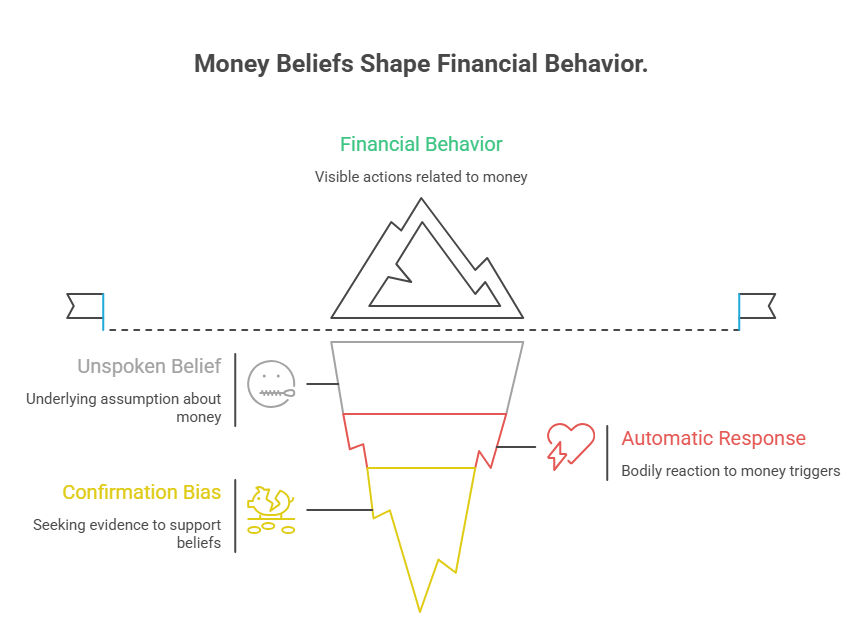
That’s the loop. Rule, Reaction, Receipt — and then the Receipt feeds straight back into the Rule, stronger than before. Same pattern, every payday, until somebody names it.
This is the same mechanism behind the Identity Reinforcement Loop we’ve been working with for months — just running on your bank balance instead of your self-talk.
Where the Rule Actually Comes From
Black Tax gets talked about like it’s a maths problem. It isn’t. It’s an inherited Rule about what family obligation is supposed to cost you.
Ubuntu — the actual principle behind it — was never about one person quietly carrying an entire household alone, forever, with no boundary. It was about mutual, visible support. Everyone contributes. Everyone is seen contributing.
Somewhere between the principle and the practice, a Rule formed for a lot of us: give first, ask never, budget last. And it doesn’t check your income before it runs you. It shows up the same way whether you’re a student stretching a bursary, someone on a retail floor still stuck on payday, a hustler running a chair or a spaza till the bank doesn’t recognise it yet, or a professional quietly funding two households on one salary.
Different lives. Same inherited Rule.
None of this means stopping support for your family. It means the support should come from a decision, not an autopilot Reaction you never agreed to.
The Move
You can’t interrupt a pattern you can’t name. This week, the whole assignment is naming it.
1. Name your Rule. Finish this sentence in your own words: “In my house, money was for ___, and if it ran out, that meant ___.”
2. Catch the Reaction. Next time money lands — payday, a side hustle payout, a gift — notice the first thing your body does before you decide anything. That’s the Reaction.
3. Delay the Receipt. Give yourself 24 hours before any decision bigger than groceries. The Rule wants to move fast. Let it wait.
4. Write a new Rule. One sentence. Not a philosophy — a sentence you could say out loud to your own household one day.
5. Create one small Receipt this week. One decision, however small, that proves the new Rule instead of the old one.
The Counterintuitive Part
Budgeting isn’t a math problem. It’s an identity problem.
You can download every app, build every spreadsheet, and still end up broke by the 20th — if the Rule underneath hasn’t changed. The maths was never the missing piece. The Rule was.
FAQs
What is “black tax” and how does it affect budgeting?
It’s the ongoing financial support many people are expected to give family, often without a set boundary. Left unexamined, it becomes a Rule that decides your budget before you do.
Can you actually change an inherited money habit as an adult?
Yes — but not by willpower alone. You interrupt it by naming the Rule behind it, the same way identity change works everywhere else in this series.
Why do I feel guilty when I save money instead of spending or giving it away?
Guilt is usually the Reaction defending the old Rule. It’s a signal, not a verdict.
How do I budget when my income is irregular, like a hustle or informal income?
Budget against your lowest realistic month, not your best one. The Rule, Reaction, Receipt loop still applies — it just moves on a different schedule.
What’s the difference between a money habit and a money Rule?
A habit is what you do. The Rule is why you keep doing it, even when it stops working.
Why does payday make me anxious instead of relieved?
Because for some households, payday was historically the moment when scarcity either got solved or confirmed. Your body remembers that, even now.
How do I talk to my family about money boundaries without it becoming a fight?
Lead with the decision, not the accusation. “I want to help, and I need to plan it in advance” lands differently than “you always ask for too much.”
Is it normal to spend money almost immediately after getting paid?
It’s common — and it’s usually a Reaction, not a character flaw. Naming it is the first step to changing it.
How much of my income should go to family obligations?
There’s no universal number. The Move here isn’t a percentage — it’s making the number a decision instead of a default.
Can therapy or counselling help with money anxiety?
It can, especially where the anxiety runs deeper than budgeting. If that’s you, a conversation with a professional is a reasonable next step alongside this work.
What’s the first step to breaking a bad money pattern?
Name the Rule. Everything else in this series builds from that one sentence.
How do I start saving on a low or irregular income?
Start with an amount so small it feels almost pointless. The point isn’t the amount. It’s proving to yourself the new Rule can hold.
Why do some people freeze up completely around money decisions?
Freezing is a Reaction too — it just looks like inaction instead of spending. Same loop, different symptom.
Is budgeting different if you’re self-employed or running a hustle?
The tools shift. The underlying Rule usually doesn’t. Name it first, then adjust the tools.
What if my partner and I inherited different money Rules?
Name both rules out loud, separately, before trying to merge a budget. You’re not merging numbers first — you’re merging two different inheritances.
Worth a Look
| Resource | Why it helps |
| The Psychology of Money — Morgan Housel | Reframes money as behaviour, not arithmetic — the whole premise of this week’s post |
| A stokvel or community saving circle | A working, existing model of the ubuntu principle behind black tax — worth studying before you reject or over-give to it |
| A simple budgeting app (e.g. 22seven) | Tracks spending against your actual patterns automatically, so the Rule shows up in the data, not just the feeling. |
One Thing Before You Go
A week ago, “I’m just bad with money” was the whole explanation you had.
Now you have a name for what’s actually happening — a Rule, a Reaction, a Receipt, closing the loop every payday.
Write your Rule down today. That’s the whole Move.

Follow the WhatsApp channel. Week 2 starts unlearning it, one Monday at a time.
Money You Didn’t Learn At Home Series:
- The Money Rules Nobody Taught You — You Are Here