You have a gift. Someone else has a problem your gift solves. Purpose lives in that intersection.
Read that again. Slowly. Because most of us spend years looking for purpose in the wrong place, in a job title, a qualification, or a five-year plan typed up at 2am when we couldn’t sleep. And the whole time, the answer is sitting quietly in the thing we’re already good at, waiting for someone to point it at a problem.
I used to think purpose was a discovery. Like it was buried somewhere and I needed a map. Turns out it’s closer to a decision. You take what you already carry—the skill, the sensitivity, the weird thing you’re better at than everyone else you know—and you aim it at somebody else’s need. That’s it. That’s the whole mechanism. Everything after that is just practice.
The Gift + Problem = Purpose Model
Here’s the simplest way I can put it: your gift only becomes purpose when it meets a problem it can solve.
A gift sitting alone is just a skill. It’s nice at parties. It might even pay a salary. But the moment you point it at someone else’s struggle—a friend’s business that’s bleeding cash, a neighbor’s kid who can’t read, a group chat full of people asking the same question you already know the answer to—it’s not a talent anymore; it’s a tool.
Think of it as an intersection, not a ladder. You’re not climbing toward purpose. You’re standing at a crossing point:

- Your gift—what you do well, almost without trying
- Their problem—what’s genuinely broken, missing, or hard for someone else
- The overlap—where your gift actually fixes their problem
That overlap is small, specific, and usually closer than you think. You don’t need to solve poverty. You need to solve the one problem in front of you that your gift happens to fit.
The Weight of Skill in a Community-Built Culture
There’s a reason this hits different when you grow up here. In much of the West, gifting is framed as personal branding—a personal asset you monetize for yourself. In most South African communities, skill has always carried a social debt. Somebody taught you and covered for you while you learned. Somebody’s stokvel, spaza shop, or backyard hustle kept your family fed while you found your feet.
That’s the logic of Ubuntu, whether you’d call it that or not: I am because we are. Your gift was never fully yours to hoard. It was community capital, loaned to you early, expected back in some form.
This isn’t guilt-tripping you into burnout. It’s context for why “use your gifts to serve others” lands as more than a nice sentiment here—it’s closer to how the township economy has always worked. The guy who fixes phones teaches the next guy. The woman who started the crèche mentors the one two streets over. Skill moves in circles, no straight lines to the bank.
If you’re sitting with a gift and wondering what it’s for, that’s your answer: it’s for the circle you’re standing in right now.
The Purpose Mapping Exercise
This is the move. Grab a notebook, your notes app, or whatever, and actually do this; don’t just read it.
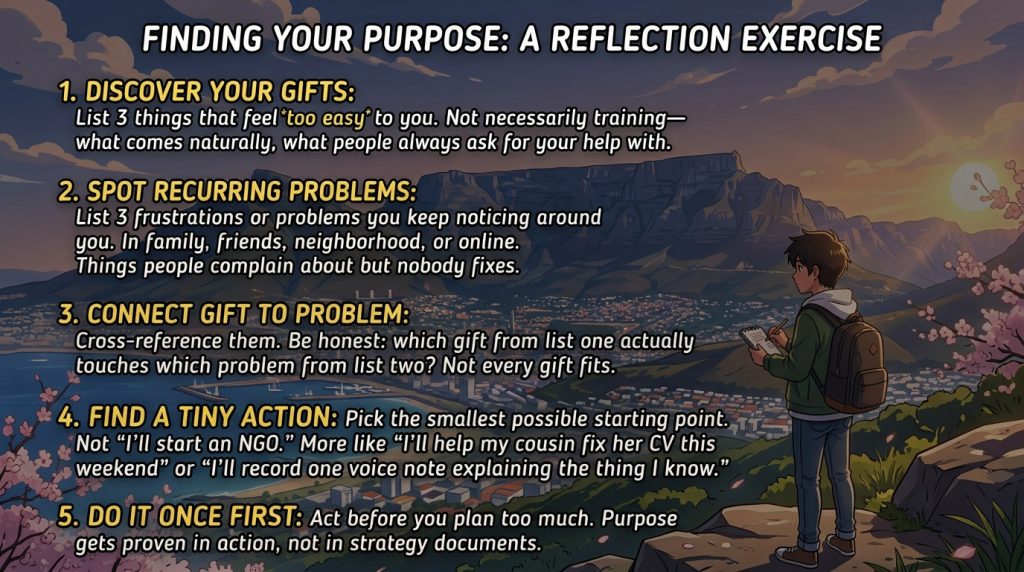
That’s the whole exercise. It takes fifteen minutes and a bit of honesty.
A Warning: Purpose Doesn’t Require Perfection
Here’s where a lot of people quietly disqualify themselves. They wait to feel gifted enough. They wait for the skill to feel polished, the confidence to feel settled, the moment to feel obviously right.
It’s not coming, not like that.
Purpose doesn’t require perfection—it requires direction.
You can serve someone with a gift that’s 60% developed. You can bless someone with a talent you’re still slightly embarrassed about. The direction matters more than the finish. Aim the thing you have at the problem in front of you, and let the polish happen on the way there, not before you start.
Frequently Asked Questions
What does “use your gifts to serve others” actually mean?
It means taking whatever you’re naturally capable of a skill, a sensitivity, or a way of thinking and deliberately pointing it at someone else’s need instead of keeping it purely for yourself.
What Bible verse says to use your gifts to serve others?
1 Peter 4:10 is the classic reference: each person should use whatever gift they’ve received to serve others as faithful stewards of God’s grace in its various forms.
Does “gifts” in 1 Peter 4:10 mean only spiritual gifts, or also talents and skills?
Scholars generally read it broadly; spiritual gifts sit inside a wider category of grace given for others, which includes natural talents and learned skills used in service.
How do I know what my gifts are?
Look at what people consistently ask you for help with, what you do without being told, and what feels effortless to you but impressive to others. Those overlaps are usually where your gift lives.
What if I don’t feel gifted at anything—can I still serve?
Yes. Most people underrate ordinary competence, organizing, listening well, and showing up reliably because it doesn’t feel dramatic. Ordinary, consistent skill is still a gift.
How can I use my everyday talents (work, hobbies) to serve others?
Take the thing you already do for pay or fun and ask who around you struggles with that exact thing. A spreadsheet whiz can help a small business owner track stock. A good cook can teach a neighbor to meal-prep on a budget.
What are practical ways to start serving with my gifts this week?
Pick one person with one problem your gift fits, and help them once; no long-term commitment required. Small, specific, immediate.
How do I serve others without burning out or overcommitting?
Set a boundary before you start: a time limit, a headcount limit, or a season limit. Serving sustainably beats serving heroically for three weeks and disappearing.
Can I use my gifts to serve outside of church (in my community, workplace, or online)?
Absolutely. Service isn’t confined to a building. Your WhatsApp group, your workplace, and your street are all valid places for your gift to meet problems.
What if I’m afraid people will judge me when I use my gifts?
Judgment is mostly noise from people not in the room where it matters. Focus on the one person your gift is actually helping; their relief is louder than anyone’s opinion.
How do I balance serving others with taking care of my own needs?
Serving from an empty tank helps nobody for long. Protect your own rest and needs as part of the plan, not as a guilty afterthought.
What does it mean to be a “faithful steward” of God’s grace in this context?
It means treating your gift as something entrusted to you for others’ benefit, not just your own gain, and managing it responsibly rather than owning it selfishly.
How can I involve my family or kids in serving with their gifts?
Name their gifts out loud, then give them a real, small problem to solve with it: a younger cousin to tutor, a task at home that’s genuinely theirs to own.
How do I keep serving when I don’t see immediate results or appreciation?
Track the act, not the applause. Keep a simple log of what you did and for whom it keeps you anchored when gratitude doesn’t show up on schedule.
What’s the difference between talents, spiritual gifts, and calling, and how do they work together in service?
Talents are natural abilities, spiritual gifts are grace-given capacities for others’ benefit, and calling is the direction all of it points toward over time. Service is usually where the three overlap.
Where to Go Deeper
If you want structured support working through your own gift-to-purpose mapping, these resources go further than a blog post can:
| Resource | Why it helps |
| The Call – Os Guinness | Connects gifts, daily work, and service to a bigger sense of purpose |
| You Are Called – Johnn Bevere | Guided reflection questions to activate your gifts for service |
| The Purpose Driven Life – Rick Warren | A 40-day framework for aligning gifts, values, and service |
| Boundaries – Cloud & Townsend | Essential if you tend to over-serve and burn out |
| Atomic Habits — James Clear | Turns “I should serve more” into a repeatable weekly habit |
Final Word
You don’t need a bigger gift. You need to point the one you already have at the nearest real problem. Do the mapping exercise above today, not next month, not “when things settle down.” Fifteen minutes, a notebook, and honesty.
Your Next Visible Step
If you want a simple weekly nudge to keep mapping your gift to real problems around you and eventually turn that gift into something that scales—join the WhatsApp channel. It’s where we work through exactly this, one practical step at a time.
Rebuild the Person Who Can Build the Future Series:
- You Can’t Build a New Future With an Old Version of Yourself
- How Self-Perception Shapes Success More Than Talent
- Your Feelings Are Real. But They Don’t Get to Be in Charge
- Mindset Shift Consistency: The Boring Season
- You Need to Trust Yourself First — Here’s How to Earn It
- You’re Just Building the Version That Will Actually
- How to Use Your Gifts to Serve Others: A Practical Guide.- You Are Here