
Think about the last time you told yourself you’d wake up at 5am. Or start the business plan. Or finally send the application. You meant it. You really did. And then the alarm went off, and you hit snooze, and some quiet part of you took note.
That part of you is always taking notes.
Here’s the thing nobody tells you about building self-trust: it’s not a personality trait. It’s not something you either have or don’t. It’s a record. A running tally your own mind keeps of every promise you made to yourself and whether you kept it. And if that tally is mostly red, no amount of motivation, vision boards, or 5am wake-up calls will fix it, because the problem was never your discipline. It was that you stopped believing your own word.
The Quiet Erosion: How “I’ll Start Monday” Becomes a Lifestyle
It doesn’t happen in one dramatic moment. Nobody wakes up and decides, “Today I will stop trusting myself.” It’s slower than that. Sneakier.
It’s the gym membership you paid for in January and haven’t used since February. It’s the “I’ll reply tomorrow” that became three weeks long. It’s the version of you that said “just this once” so many times that once became your default setting.
Each broken promise feels small on its own. Harmless, even. But your brain isn’t grading you on intention — it’s grading you on evidence. And every “I’ll start Monday” that quietly becomes “I’ll start next Monday” is evidence you’re filing against yourself, whether you notice it or not.
By the time you’re an adult wondering why you can’t stick to anything, you’re not lazy. You’re not lacking willpower. You’re just reading your own track record accurately — and it’s telling you that your word doesn’t mean much. That’s a painful thing to sit with. But it’s also, weirdly, good news, because a track record can change.
The Credibility Bank: How Self-Trust Is Built and Broken
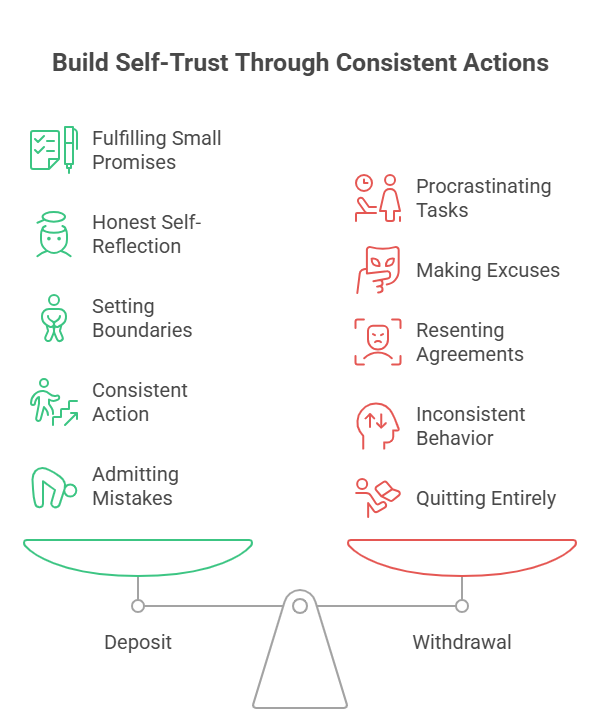
Imagine you have a bank account. Except instead of money, you’re depositing and withdrawing credibility with yourself. Every time you say you’ll do something small — and you do it — you make a deposit. Every time you bail, you make a withdrawal.
Most people are walking around with an overdrawn account and wondering why they feel so unstable.
This is the foundation of self-integrity: doing what you said you’d do, especially when nobody’s watching, and there’s no reward for it. Not the big, Instagrammable stuff. The boring stuff. Drinking the water. Sending the text. Closing the laptop when you said you would.
Here’s the part people miss: self-confidence and self-trust are not the same thing, and confusing them is where people get stuck.
Self-confidence is what you believe about your abilities. Self-trust is what you know about your consistency. You can be confident and still bail on yourself constantly. You can also be deeply unsure of your talent and still trust yourself completely — because you know that whatever happens, you’ll show up and follow through. Confidence is a feeling. Trust is a track record. Build the record, and the feeling tends to follow.
The SA Lens: Why We Outsource Our Worth (And Why It’s Costing Us)
Let’s be honest about something specific to growing up here. Whether it’s your family group chat, your church, your neighbourhood, or the culture of “what will people say,” a lot of us were raised to look outward for validation before we ever learned to look inward.
You did well because your report card said so. You were a good person because your pastor said so. You were on the right path because your relatives at the family gathering approved. External validation became the currency, and inner authority, trusting your own read on your own life, never really got the practice it needed.
The problem is that external validation is a moving target. The moment you need someone else to confirm you’re doing okay, you’ve handed your peace of mind to people who don’t live inside your head, don’t know your context, and often haven’t figured out their own lives either.

This shows up loudly in how many young South Africans chase visible markers of success – the car, the “clout”, and the wedding before the foundation, not because those things are bad, but because self-reliance got skipped in favour of applause. And applause is loud, but it’s also unreliable. It claps for you one season and criticises you the next. Your own inner authority doesn’t do that. It’s steady. But only if you build it.
Building it starts with a strange but necessary shift: learning to trust your judgement even when nobody’s clapping. Especially then.
The Move: The 5-Day Self-Trust Challenge
Theory is nice. But you didn’t come here for a lecture — you came here because something in you is tired of not following through. So let’s do something about it.
This isn’t about overhauling your entire life in five days. It’s about making five small, undeniable deposits into your credibility bank.
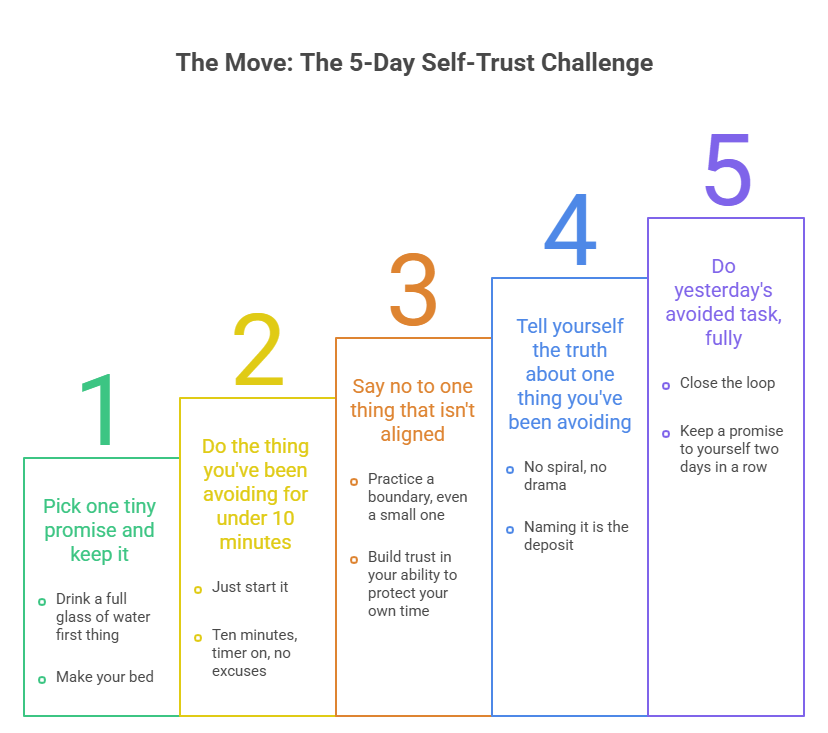
Close the loop. Feel what it’s like to keep a promise to yourself two days in a row.
Five days. Five deposits. It won’t fix everything, but it will prove something your nervous system needed proof of: that your word is starting to mean something again.
The Mirror: Signs Your Self-Trust Is Low
Not sure if this is even your issue? Here are some signs that you have low self-trust, without the jargon:
- Ask five people for their opinion before making a decision you already knew the answer to.
- You stopped setting deadlines for yourself because you assume you’ll miss them anyway.
- Over-apologise, even for things that don’t need an apology.
- The inner critic runs the show, and it sounds suspiciously like every disappointed adult from your childhood.
- You say yes fast and regret it slower.
- Small mistakes send you into a spiral instead of a shrug.
- Keep starting over instead of building on what you already did.
If even three of those landed a little too close, don’t panic. This is fixable. It’s not a character flaw — it’s a pattern, and patterns can be interrupted.
Frequently Asked Questions
What does it mean to build self-trust?
It means becoming someone whose word — even said privately, to yourself — is reliable. It’s built through small, consistent follow-through, not one big breakthrough moment.
Why do I struggle to trust myself?
Usually because of a backlog of broken promises, past mistakes you never fully processed, or growing up depending on outside approval instead of your own judgement.
How long does it take to build self-trust?
There’s no fixed number, but momentum tends to show up within a couple of weeks of consistent small wins. It’s slower to rebuild than it was to break; be patient with the process.
What is the difference between self-trust and self-confidence?
Confidence is belief in your ability. Trust is proof of your consistency. You can have one without the other, but real stability needs both.
How can I trust my intuition more?
Test it on small things first, and track how often it’s right. Most people ignore their intuition so often they never build the evidence that it’s worth listening to.
How do I rebuild self-trust after making mistakes?
Own the mistake honestly, without spiralling into shame, and make the very next promise to yourself a small one — then keep it.
What habits help strengthen self-trust?
Keeping small commitments, being honest with yourself, setting and holding boundaries, and reflecting daily through journaling.
Can self-trust reduce anxiety and overthinking?
Often, yes. A lot of overthinking is your mind searching for certainty it doesn’t trust you to handle without a plan for every outcome. Reliable follow-through reduces that need.
What are signs that I have low self-trust?
Constant outside validation-seeking, missed self-set deadlines, over-apologising, a loud inner critic, and abandoning things at the first mistake.
Tools to Support the Work
If you want something physical to anchor the process, a guided journal can help turn the 5-day challenge into a daily habit instead of a one-off exercise.
| Journal | Why It Helps |
| Clever Fox Self-Love Journal | Structured prompts for daily self-compassion and habit building |
| INSIDE THEN OUT Better Every Day Journal | 365 pre-dated pages for daily growth and consistency |
| Clever Fox Mental Health & Anxiety Journal | CBT-style prompts for reframing thoughts and spotting triggers |
| 365 Questions, One Page Per Day | One question daily for quick, honest reflection |
| Self-Love Workbook for Women | Exercises for self-worth and mindset shifts |
The Bottom Line
You don’t need more discipline. You need a better track record with yourself — and that starts with promises small enough to keep and important enough to matter.
Self-trust isn’t loud. It doesn’t announce itself. It just quietly shows up, one kept promise at a time, until one day you realise you no longer need everyone else’s approval to know you’re on the right path. You already know. You proved it to yourself.
Ready to start? Join the WhatsApp channel and run the 5-Day Self-Trust Challenge with the community — because doing it alongside people who are rebuilding too makes the follow-through easier to keep.
Rebuild the Person Who Can Build the Future Series:
- You Can’t Build a New Future With an Old Version of Yourself
- How Self-Perception Shapes Success More Than Talent
- Your Feelings Are Real. But They Don’t Get to Be in Charge
- Mindset Shift Consistency: The Boring Season
- You Need to Trust Yourself First — Here’s How to Earn It — You Are Here
Share this post: on Twitter on Facebook