Here’s the uncomfortable truth nobody wants to say out loud: discipline isn’t a skill you practice — it’s a person you become.
Most people treat self-discipline like a muscle you flex when you feel like it. You set an alarm for 6 AM. They download a habit tracker. They buy a new journal. And then, two weeks later, the journal is under the bed, and the 6 AM alarm is just noise.
The reason? They tried to change their behaviour without changing their identity. They treated discipline as something they do, not something they are.
This post is a confrontational reframe. First, I’m going to challenge the way you think about discipline, habits, and consistency because the version of it you’ve probably been sold is keeping you stuck.

The Biggest Misconceptions About Discipline
Let’s get this out of the way first: discipline is not about willpower. It’s not about white-knuckling your way through hard things. For instance, it’s not about waking up at 5 AM unless that actually serves your life. And it definitely isn’t about punishing yourself every time you slip.
The most common misconceptions that keep people stuck:
- Discipline requires constant motivation. No. Motivation is a feeling. Feelings come and go. Discipline is a structure that doesn’t rely on feeling ready.
- Disciplined people never feel like quitting. Wrong. They feel it constantly. Even so, the difference is that they act anyway, because the action is tied to who they’re choosing to become, not how they feel in the moment.
- You’re either born with it, or you’re not. Discipline is completely learnable. It just takes building it from the inside out.
- Being hard on yourself builds discipline. It destroys it. Self-criticism spikes cortisol, triggers avoidance, and trains your brain to associate effort with pain.
| “Discipline isn’t the absence of freedom. It’s the agreement you make with your future self.” |
Once you clear out these myths, you make space for what actually works.
Why Disciplined People Think Differently
Here’s what separates people who follow through from people who don’t: it’s not their schedule, it’s their story.
Disciplined people don’t think “I should work out today.” They think, “I’m someone who takes care of their body.” That subtle shift changes everything. When your action is attached to identity, skipping feels like a betrayal of yourself, not just a missed workout.
Research backs this up. In a 2012 study by Vanessa Patrick and Henrik Hagtvedt, people who said “I don’t skip workouts” were significantly more consistent than those who said, “I can’t skip workouts.” One is a rule. The other is a reflection of who you are.
Beyond that, disciplined people also:
- They make decisions in advance, so they’re not relying on in-the-moment willpower
- Design their environment to reduce friction between intention and action
- Treat consistency as a form of self-respect, not punishment
- Accept that discipline is uncomfortable and choose it anyway
| 🔑 IDENTITY SHIFT Stop asking “How do I become more disciplined?” Start asking “What would a disciplined person do right now?” Then do that. Repeat until it’s you. |

Discipline as Identity Reinforcement
This is the core of what Life Coaching Animated calls the Identity Reinforcement Loop, and it explains why discipline either snowballs into unstoppable momentum or collapses after week one.
Here’s how it works:
- Your self-image drives your behaviour. If you see yourself as someone lazy, scattered, or undisciplined, you’ll unconsciously act in ways that confirm that story.
- Your behaviour creates evidence. Every action, however small, becomes data about who you are. As a result, you either gather evidence that confirms the old identity or start building a new one.
- Evidence reinforces the self-image. Over time, those micro-moments of follow-through stack into a picture of yourself that feels true. And that image drives the next round of behaviour.
This is why one small win matters more than you think. Every time you do what you said you’d do, even something tiny like making your bed or responding to one email, you cast a vote for the identity of “someone who follows through.” Stack enough votes, and you don’t have to force discipline. It becomes your default.
| “The goal is not to hit targets. The goal is to become someone who consistently shows up.” |
The trap most people fall into is waiting to feel disciplined before acting. But the loop doesn’t start with feelings. It starts with a single action, any action, that gives you evidence of who you’re becoming.
The Compound Effect of Disciplined Behaviour
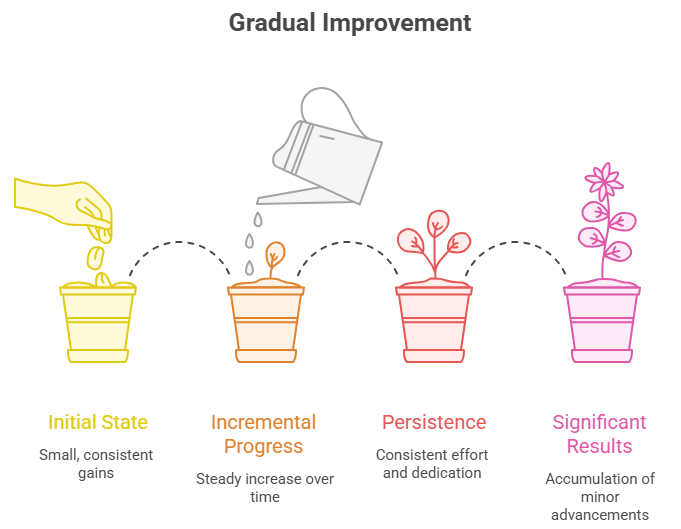
You’ve probably heard of compound interest. The idea is that small amounts, reinvested consistently, grow into something exponentially larger over time. Discipline works the same way.
One workout doesn’t change your body, but ninety-two workouts over six months? That’s a different body and, more importantly, a different identity. One journal entry doesn’t rewire your self-talk. But three hundred entries? You’ve built a habit of introspection that shapes every decision you make.
James Clear, author of Atomic Habits, puts it brilliantly: a 1% improvement every day leads to being 37 times better in a year. That’s the compound effect of disciplined behaviour, not dramatic leaps, but persistent, boring, daily choices that accumulate into something extraordinary.
| ⚡ The math of discipline: 1% better every day for a year = 37x growth. 1% worse every day = you’ve nearly lost everything you had. Consistency isn’t optional. It’s the whole game. |
And here’s the important flip side: the compound effect works in reverse, too. Every time you back out on yourself, every time you say “I’ll start Monday” and don’t, you’re compounding evidence that you’re not following through. That story gets harder to overwrite the longer it runs unchallenged.
The antidote? Start small. Embarrassingly small. The goal isn’t to impress anyone, including yourself. The goal is to generate evidence that the loop is turning in the right direction.
The Practical Discipline Loop: 5 Steps to Build It Today
Enough theory. Here’s how you actually build discipline using the Identity Reinforcement Loop as your engine:
STEP 1: NAME YOUR IDENTITY TARGET
Don’t set a goal. Set an identity. Instead of “I want to exercise more,” say “I am someone who moves their body every day.” Write it down. Say it out loud. Feel how different those lands.
STEP 2: CHOOSE ONE KEYSTONE HABIT
Pick one daily action that directly supports that identity. Just one. The simplest version possible. “Someone who moves their body every day” starts with ten minutes of walking. Not a gym membership. Not a programme. Ten minutes.
STEP 3: LOCK IN THE TRIGGER
Attach your new habit to something that already happens. “After I pour my morning coffee, I do ten minutes of walking.” This is called habit stacking, and it removes the decision entirely. The trigger fires automatically; the habit follows.
STEP 4: TRACK THE STREAK – BUT NOT FOR THE STREAK’S SAKE
Use a tracker, an app, a calendar, even a piece of paper with checkboxes, not to maintain a perfect record, but to generate visible evidence of follow-through. Every tick is a vote. Every vote reinforces the identity. Apps like Streaks, Habitica, or even Notion work well here.
STEP 5: RECOVER FAST, NOT PERFECTLY
You will miss a day. Plan for it. The rule is never to miss twice in a row. One miss is an accident. Two misses is the beginning of a new pattern. The goal isn’t perfection, it’s a fast recovery that reinforces your identity as someone who bounces back.
| 🔄 THE LOOP IN REAL TIME Identity → Action → Evidence → Reinforced Identity. Run this loop daily. Don’t wait for motivation. The loop creates its own momentum. |
Tools & Resources – Your Discipline Practice
The right tools don’t build discipline for you but they reduce friction and keep you accountable. Here are some of the most effective ones, from books that rewire how you think to apps that track your progress:
| # | Product | Description |
|---|---|---|
| 1 | Atomic Habits – James Clear | Building small habits that lead to lasting discipline |
| 2 | Mindset – Carol S. Dweck | Shifting beliefs about ability and growth |
| 3 | The Power of Habit – Charles Duhigg | Understanding how habit loops form and change |
| 4 | The Willpower Instinct – Kelly McGonigal | Science-backed self-control strategies |
| 5 | Deep Work – Cal Newport | Focus and eliminate distractions |
| 6 | Can’t Hurt Me – David Goggins | Extreme mental toughness and resilience |
| 7 | Mindful Self-Discipline – Giovanni Dienstmann | Practical self-mastery with mindfulness |
| 8 | Streaks (app) | Daily habit tracking and consistency |
Frequently Asked Questions–Discipline & Habits
What is a disciplined mindset?
A disciplined mindset is the internalized belief that your actions are an expression of who you are, not just tasks you complete. It means operating from identity rather than impulse making choices based on your long-term self-image rather than short-term feelings. A disciplined mindset says “this is what I do” rather than “I’ll try to do this.”
How do I develop self-discipline?
Start by tying a single small action to a clear identity statement. “I am someone who…” Then make the action so easy it’s almost impossible to fail. Consistency at a low level beats sporadic effort at a high one. Build momentum first, volume later. The Identity Reinforcement Loop does the rest.
Why is discipline more important than motivation?
Motivation is an emotion. It shows up when things are exciting and disappears the moment they get hard. Discipline is structural it doesn’t depend on how you feel. Disciplined people act when unmotivated. That’s the entire advantage. You can’t build a reliable life on a feeling that fluctuates daily.
How can I stay consistent every day?
Eliminate decisions. Use habit stacking attach your new habit to an existing trigger. Keep the action small enough that resistance is minimal. Track your streak visually. And apply the “never miss twice” rule one missed day is a blip; two is a pattern. Focus on showing up, not on showing up perfectly.
How do I stop procrastinating and become disciplined?
Procrastination is almost always an emotion-regulation problem, not a time-management problem. You’re avoiding the discomfort of starting. The fix: make starting the only obligation. Set a two-minute rule, commit to just two minutes of the task. In most cases, starting breaks the avoidance loop. Identity also helps: “disciplined people start before they’re ready” is a belief that counters procrastination at the root.
Can discipline be learned, or is it natural?
Completely learnable. Neuroplasticity means your brain rewires in response to repeated behaviours. Every time you follow through on a commitment even a small one you’re literally strengthening the neural pathway that makes follow-through feel natural. Disciplined people weren’t born that way. They just started earlier and kept going.
What is the difference between self-control and discipline?
Self-control is reactive it’s the ability to resist a temptation in the moment. Discipline is proactive it’s the structure you’ve built, so the temptation has less power in the first place. Self-control says, “I won’t eat the cake.” Discipline says, “I’ve already made my meals for the day, so the cake isn’t really a decision.” One is a battle. The other is a system.
What are the best daily routines for discipline?
A solid discipline routine includes: a consistent wake time, a morning anchor habit (movement, journaling, or review), defined deep work blocks, a mid-day reset, and an evening shutdown ritual. The specific content matters less than the consistency of the structure. Routine eliminates the willpower cost of deciding, and that saved energy goes into execution.
The Identity You’re Building Right Now
Every single choice you make today is a vote. Not for a result for an identity. The person who does one push-up isn’t building a six-pack. They’re building the identity of someone who shows up. And that identity? It’s worth more than any single outcome.
Discipline isn’t the sacrifice of who you are. It’s the expression of who you’re choosing to become.
The loop is always running, reinforcing either the identity you want or the one you’re trying to leave behind. Ultimately, the only question is which direction it’s spinning.
Choose one habit. Make it tiny. Start today. Not tomorrow. Not Monday. Today. Because the person you want to be is built in the ordinary moments you thought didn’t count.
They all count.
Ready to Rewire Your Identity?
Identity Reinforcement Loop Series:
- Identity Reinforcement Loop: Self-Image
- Small Behaviours Change Your Identity
- The Stories You Tell Yourself Are Programming Your Life
- Small Wins Are Not Small: They Are Identity Evidence
- Why Inconsistency Destroys Confidence
- The Self-Trust Gap: Why You Stop Believing in Yourself
- Build Discipline Through Identity — Start Today
- Why You Feel Stuck(Even When You’re Making Progress)
- Discipline Is Identity in Action: Build Better Habits— You Are Here
Affiliate Disclaimer: Some of the links on this website are affiliate links. This means that if you click on a link and make a purchase, I may receive a small commission at no additional cost to you.