Forget willpower. The real secret to lasting discipline isn’t what you do, it’s who you decide to become.
Here’s something nobody tells you when you’re staring down your third broken promise to yourself this week: the reason you can’t seem to stay disciplined has almost nothing to do with motivation, morning routines, or the latest productivity hack you bookmarked at 2 a.m. However, it goes much deeper than that. It’s about identity.
You’ve probably tried the goal-setting approach, and you write down what you want: lose 20 pounds, launch that side hustle, finally learn Spanish, and for about a week, you’re fired up. Then life happens, and the whole thing quietly collapses. Sound familiar?
Here’s the uncomfortable truth: outcome goals almost always fail you. Not because you’re lazy or weak. But because you’re trying to build a new behavior on top of an old identity. It’s like trying to grow a plant in the wrong soil. No matter how much water and sunlight you give it, it’s fighting the ground beneath it.
This is exactly where identity-based behavior change comes in, and it’s the foundation of what researchers, coaches, and high-performers call the “discipline muscle.” So let’s break it all down.
Why Outcome Goals Almost Always Let You Down
Think about the last time you set a big goal. You were probably laser-focused on the result, the number on the scale, the bank balance, the finished manuscript. That’s the outcome. And outcomes are great for direction. But they’re terrible for daily motivation.
Why? Because outcomes live in the future. They’re distant. Intangible. And your brain, frankly, is built for the present. When the alarm goes off at 6 a.m., and you’re warm and comfortable, your future goal feels very far away. Your immediate comfort feels very real.
James Clear, author of Atomic Habits, puts it plainly: every system you follow is a vote for the person you believe you are. When your identity doesn’t match your goal, the goal loses every single time.
| “The goal is not to run a marathon. The goal is to become the kind of person who runs.” |
That shift from what you want to who you are changes everything. It moves discipline from an exhausting act of willpower into something that feels almost natural. Almost.
Identity-Based Behavior Change, Simplified
Identity-based behavior change is the idea that lasting discipline grows from the inside out, not the outside in. Instead of saying “I want to write a book,” you say “I am a writer.” Instead of “I’m trying to eat healthy,” you say “I’m someone who takes care of my body.”
It sounds almost too simple. But the psychology behind it is rock-solid.
When you declare an identity, your brain starts filtering reality through that lens. You make decisions, big and small, that reinforce it. You notice opportunities that match it. And over time, the consistent small actions compound into something real. This is literally how you build discipline muscle: through small, repeated votes for who you say you are.
The Science Behind the Identity Shift
Q: What does “build discipline muscle” mean exactly?
Think of self-discipline as a literal muscle in your brain. Just like a bicep grows stronger with consistent resistance training, your willpower and self-control grow stronger through repeated, deliberate practice. Every time you do the hard thing, choose the salad, open the laptop, lace up the shoes, you’re making that muscle a little bit stronger. Skipping the workout doesn’t just mean losing a day. It weakens the muscle.
Q: How is self-discipline like a muscle that can be trained?
Psychologist Roy Baumeister’s research on ego depletion showed that willpower behaves like a resource that can be used up, but it can also be replenished and strengthened over time. Much like physical endurance, the more consistently you train resistance, the more capacity it builds. The science of self-control confirms: discipline is trainable, not fixed.
| Old Outcome Goal Identity | New Identity Shift | Daily Habit Vote |
| “I want to get fit.” | “I am an active person.” | 10-minute walk every morning |
| “I want to save money.” | “I am someone who values financial freedom.” | Auto-transfer $10 every payday |
| “I want to read more.” | “I am a reader.” | 5 pages before sleep |
| “I want to stop procrastinating.” | “I am a person who starts before I feel ready.” | 2-minute rule on tasks |
| “I want to be more disciplined at work.” | “I am a focused professional.” | Phone in another room during deep work |
Real-World Examples of Identity Shifts That Work
Let’s make this tangible. Because theory is great, but you need to see this thing in action.
1. David Goggins — from an overweight exterminator to a Navy SEAL. He didn’t just “get fit.” He declared himself a warrior and built every habit around that identity. His entire discipline framework was identity-first — he decided who he was before his body caught up.
2. Oprah Winfrey — from victim of circumstance to media mogul Oprah has spoken openly about the moment she stopped seeing herself as someone things happened to, and started identifying as a creator of her own story. The behavioral shift followed immediately.
3. James Clear — from an injured athlete to a habits writer, Clear himself is a living example. After a serious baseball injury, he rebuilt his identity around being someone who masters small, daily habits, which eventually became Atomic Habits.
4. Kobe Bryant — from talented kid to “the Mamba” Kobe literally created an alter ego (Black Mamba) to embody a disciplined, relentless identity separate from his regular self. The identity came first; the 4 a.m. workouts followed.
5. Michelle Obama — from South Side Chicago girl to First Lady. She has repeatedly credited her discipline, which she decided early she was “that girl who does the work” — she made an identity declaration as a teenager that governed every decision after.
| Key Insight: You don’t need to feel like the person you want to become. You need to act like them enough times until the evidence starts to pile up. Identity follows behavior, and behavior follows declared identity. It’s a loop you can start at any point. |
How to Train Self-Discipline Like a Muscle: The Practical Psychology
Here’s where we get into the nuts and bolts. Because changing your identity sounds great in theory, but without the right habits to back it up, it stays in your head. And ideas that stay in your head don’t build discipline muscle.
Q: What exercises help strengthen the discipline muscle?
Start small and build resistance gradually. Try: (1) a daily micro-commitment, one small thing you do no matter what; (2) digital minimalism windows, block distraction for 25 minutes at a time; (3) delayed gratification practice, wait 10 minutes before giving in to impulse; (4) cold exposure or early rising voluntary discomfort trains the brain to resist ease. These daily exercises for self-discipline don’t require massive effort, just consistency.
Q: How long does it take to build self-discipline muscle?
Research from University College London suggests habits take anywhere from 18 to 254 days to solidify, with 66 days being the average. For your discipline muscle specifically, you’ll notice meaningful change in 4–6 weeks of consistent practice. The keyword is consistent, not perfect. Discipline fatigue is real, and rest is part of the system.
Why Your Discipline Gets Tired (And What to Do About It)
Q: Can discipline muscle get tired or depleted like physical muscles?
Yes, and this is critical to understand. Baumeister’s ego depletion research shows that willpower is finite within a day. Decision fatigue, emotional stress, poor sleep, and blood sugar dips all weaken your discipline muscle in real-time. This is why top performers design their environment to reduce the number of choices they have to make. Automate the easy stuff so you can spend your willpower on what matters.
Q: What role does resistance play in discipline training?
Resistance is the whole point. Just like a muscle grows stronger through weight, through something that pushes back, your discipline grows when you do hard things on purpose. Every time you resist a temptation, delay gratification, or show up when you don’t feel like it, you’re doing a rep. Over time, those reps compound. This is what building willpower through resistance means in practice.
| Discipline “Workout” | Difficulty | Muscle Targeted | Frequency |
| 5-minute meditation | Beginner | Focus & impulse control | Daily |
| No-phone morning block | Beginner–Intermediate | Habit resistance | Daily |
| Pomodoro (25/5 work cycles) | Intermediate | Deep focus endurance | Daily |
| Cold shower | Intermediate–Hard | Discomfort tolerance | 3–5×/week |
| Weekly digital detox (1–2 hrs) | Hard | Dopamine regulation | Weekly |
| Journaling your identity | Beginner | Identity reinforcement | Daily |
How Habits Contribute to Building Your Discipline Muscle
Q: How do habits contribute to building discipline muscle?
Habits are the reps. Each small, consistent habit is a vote for your new identity. The beautiful thing is that habits, once formed, run on autopilot, and they don’t drain your willpower. This is why consistency muscle training is really about stacking small habits until the big ones stop feeling hard. Stephen Guise’s Mini Habits approach, committing to embarrassingly small daily habits, works because it removes resistance while still casting votes for your identity. One push-up counts. One sentence counts.
Q: What are beginner tips for training discipline muscle?
Start with these: (1) Pick one habit, not five; (2) Attach it to something you already do (habit stacking); (3) Make it so easy you can’t say no, two minutes, one page, one rep; (4) Track it visually (habit trackers work because they make your streak feel real); (5) Forgive fast one missed day isn’t failure, two is a new habit. The goal isn’t perfection. It’s small habits to strengthen discipline over time.
Q: How to recover if the discipline muscle feels weak?
First, audit your basics: sleep, food, stress levels. A depleted body cannot sustain a strong discipline practice. Then, return to your smallest possible habit, not the big version, the tiny version. And revisit your identity statement. Remind yourself not what you’re trying to do, but who you’re trying to be. Discipline fatigue recovery tips always start with compassion, not punishment. You can’t shame yourself into consistency.
The Identity Declaration Exercise (Do This Now)
This is the action-driven part. It takes four minutes, and it will feel a little awkward — which usually means it’s working.
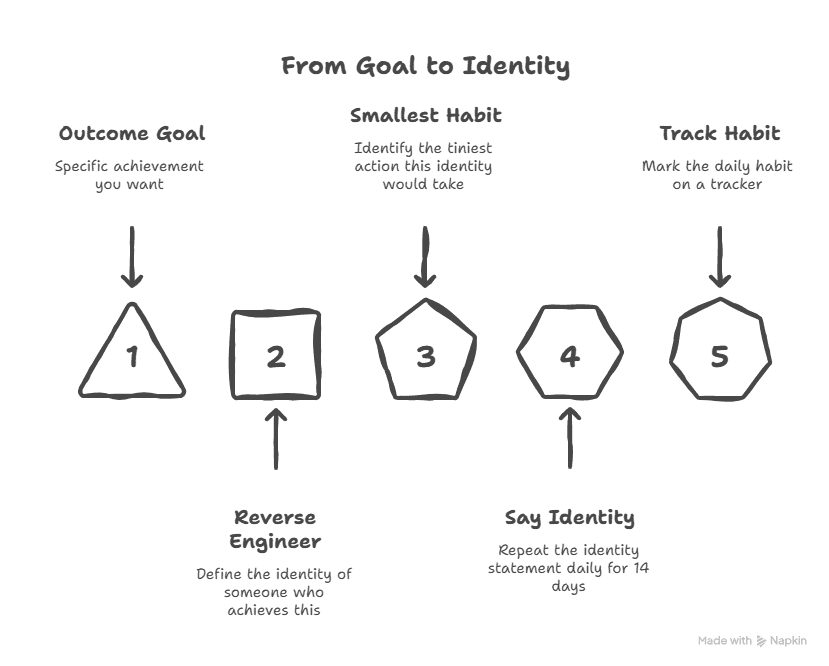
That’s it. Not a 90-day challenge. Not a complete life overhaul. Just a declaration, a tiny habit, and a tracking system. It sounds almost too small, which is exactly the point. Small is sustainable. Sustainable builds discipline muscle over time.
Q: Are there apps or tools to track discipline muscle growth?
Several excellent tools can make consistency visible and rewarding. Habitica turns habits into an RPG-style quest. Disciplinely offers gamified progress tracking. Forest App uses a focus timer to build distraction resistance. Headspace and Simple Habit support the meditation side of impulse control. For data lovers, the Strides App tracks goal progress clearly. The right tool is whichever one you’ll actually open every day.
Top Resources to Accelerate Your Discipline Training
These are the books and tools worth your time if you’re serious about building a discipline muscle that lasts.
- Atomic Habits — James Clear — The definitive guide on tiny habit changes for remarkable results.
- No Excuses! — Brian Tracy — Audiobook on goal-setting, impulse control & daily discipline.
- Mini Habits — Stephen Guise — The science of starting embarrassingly small and winning big.
- Mindset — Carol Dweck — Growth mindset as the foundation for lasting self-discipline.
- The Science of Self-Discipline — Peter Hollins — Science-backed strategies for habit formation.
- Disciplinely App — Habit tracker with gamified progress to keep consistency rewarding.
- Habitica — RPG-style app turning habits into quests.
- Forest App — Focus timer that turns distraction resistance into something visible.
- Headspace / Simple Habit — Meditation support for impulse control and focus.
The Bottom Line: Identity Is the System
You don’t build discipline by gritting your teeth harder. You build it by deciding who you are, and then acting like that person just enough times that it becomes undeniable. The discipline muscle isn’t something you either have or don’t have. It’s something you train, day by day, vote by vote, habit by tiny habit.
If you’ve been inconsistent, and most people have been. That’s not evidence that you can’t do this. It’s just evidence that you’ve been using the wrong strategy. Outcomes-first thinking leaves you white-knuckling it through every temptation. Identity-first thinking gives you a compass that works even on your worst days.
So start there. Who are you, right now, deciding to be? Write it down. Say it out loud. Pick one tiny habit that votes for it. And then do that habit tomorrow, whether you feel like it or not, because that’s what the person you’re becoming
- Identity Reinforcement Loop: Self-Image
- Small Behaviours Change Your Identity
- The Stories You Tell Yourself Are Programming Your Life
- Small Wins Are Not Small: They Are Identity Evidence
- Why Inconsistency Destroys Confidence
- The Self-Trust Gap: Why You Stop Believing in Yourself
- Build Discipline Through Identity — Start Today— You Are Here
Affiliate Disclaimer: Some of the links on this website are affiliate links. This means that if you click on a link and make a purchase, I may receive a small commission at no additional cost to you.