You weren’t born doubting yourself. So what happened, and more importantly, how do you get back?

There’s a specific kind of silence that happens right before you talk yourself out of something good. A job application you almost submitted or a conversation you almost started. A dream you almost chase. You feel it, that tiny pause, and then, very quietly, a voice says: Who are you kidding?
That voice isn’t a stranger. It sounds suspiciously like you. And the scariest part? The more you listen to it, the more convincing it gets.
This is what I call the self-trust gap. The growing distance between who you actually are and who you believe yourself to be. It’s not depression, nor laziness. It’s a slow erosion of self-worth that can happen to anyone: the sharp professional who suddenly feels like a fraud, the newly unemployed person who can’t remember what they were ever good at, the person in a relationship who’s forgotten they had a life before someone else’s opinion mattered more than their own.
If any of that sounds familiar, you’re in the right place. Let’s talk about what’s actually going on and how to rebuild.
What Is Self-Worth? Why It’s Not the Same as Self-Esteem
Before we go further, let’s clear something up, because people use these terms interchangeably, and they really shouldn’t.
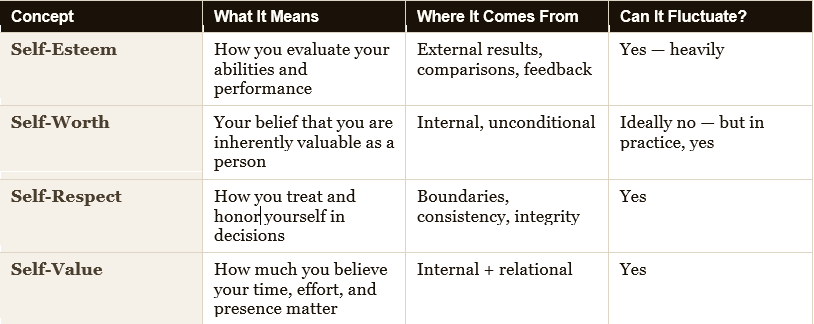
Self-esteem is conditional. It goes up when you get the promotion, down when you bomb the presentation. Self-worth is supposed to be your bedrock, the part that says, regardless of how any of that went, I still matter. The problem is that most of us were never taught to build that bedrock. So the moment things go sideways, the whole structure wobbles.

Why You Struggle with Low Self-Worth (And It’s Not Your Fault)

Low self-worth rarely arrives in one dramatic moment. It accumulates. Here’s what feeds it:
- Childhood conditioning. Were you praised for what you did, not who you were? Did love feel conditional on performance? Those early messages write the first draft of your self-image, and the editing is harder than it sounds.
- Failure without recovery. Failure is neutral. But failure without support, perspective, or a path forward? That sticks. It becomes evident that you’re the problem, not the circumstances.
- Toxic relationships. Spending years around people who minimize, dismiss, or diminish you quietly rewires what you expect from others and from yourself.
- Social comparison is accelerated by social media. You’re not just comparing yourself to your neighbor anymore. You’re comparing yourself to everyone’s best day, every day. That math never works in your favor.
- Tying worth to achievement. If “I’m good when I produce” is your internal operating system, then a job loss, a rejection, a slow season, any of these becomes an identity crisis, not just a setback.
Psychologist Nathaniel Branden, author of The Six Pillars of Self-Esteem, argued that self-esteem (and by extension, self-worth) is not a luxury; it’s a basic human need. When it’s consistently undermined, the psychological toll compounds over time.
How Past Experiences Shape Your Self-Worth Today
Here’s something that might be uncomfortable to sit with: You are still running some very old software.
The way a teacher spoke to you at age nine. The time you took a risk and got laughed at. The relationship where you were made to feel small. These aren’t just memories. They become the lens through which you interpret the present. A new boss gives you feedback, and suddenly you’re twelve again, being told you didn’t try hard enough. A partner seems distracted, and immediately your brain goes to: I must have done something wrong.
This is called negative core belief formation. It’s one of the central reasons why building self-worth isn’t just about thinking positive thoughts. You have to update the source code.

The Sneaky Role of Negative Self-Talk
Negative self-talk is the running commentary that never quite goes quiet. You’re not ready, or you’re too much. You’re not enough. They’ll figure out you’re a fraud. You’ve already failed at this before.
What makes it so powerful is that it impersonates reason. It doesn’t feel like cruelty; it feels like honesty. Protective, even. If I expect the worst from myself, I won’t be blindsided by it.
But here’s what the research actually shows: negative self-talk doesn’t protect you. It shrinks your world. A 2019 study published in Behaviour Research and Therapy found that self-critical rumination is one of the strongest predictors of anxiety and depression, more so than external stressors alone.
Overcoming it starts with one deceptively simple move: notice that you’re doing it. Not to judge yourself for self-judging (that’s a trap), but to create distance. Huh. There’s that voice again. You don’t have to argue with it. You have to stop automatically believing it.
Practical Ways to Build Self-Worth, Starting Today

Building self-worth isn’t a weekend project. It’s a practice. But there are places to start that actually move the needle.
1. Daily Habits That Shift the Baseline
- Morning journaling. Not affirmations (yet), just honest reflection. What went well yesterday? What do you notice about your thoughts? The Self Journal by BestSelf Co. is designed specifically for this kind of structured introspection over 13 weeks.
- Complete small commitments to yourself. Self-worth grows from self-trust. And self-trust grows from doing what you said you would do, even the tiny things. Every kept promise to yourself is evidence that you can rely on yourself.
- Limit inputs that shrink you. Audit your social media feed, your social circle, and the conversations you keep having. Not hermit-level isolation, just intentional curation.
- Celebrate micro-wins. Low self-worth often filters out your own evidence of competence. Start actively collecting it. Write it down. Name it.
2. Self-Compassion as a Foundation, Not a Luxury
Dr. Kristin Neff, one of the leading researchers on self-compassion, makes a distinction worth sitting with: self-compassion is not the same as self-pity. It’s treating yourself with the same basic decency you’d extend to a friend who was struggling.
When you make a mistake, the question isn’t How could I have been so stupid? The question is: What would I say to someone I love who just did this? That pivot is small in theory and enormous in practice. Brené Brown’s The Gifts of Imperfection reframes worthiness not as something you earn, but as something you practice letting yourself have.
3. Setting Boundaries as an Act of Self-Respect
Every time you say yes when you mean no, you send yourself a message: my comfort and needs are negotiable. Repeat that enough times and the message becomes a belief.
Boundaries are not about being difficult. They’re about being honest with yourself first, then with others. The Book of Boundaries by Melissa Urban is one of the most practical guides for people who’ve been taught that saying no makes them selfish or unlovable.
4. Exercises That Build Self-Worth Quickly
- The “evidence journal” — Write down three specific examples per week of times you showed up, handled something well, or did something kind. This counteracts the negativity bias that filters out your own competence.
- The “future self” letter — Write from your future self (five years from now) to your present self. What would that version of you want you to know?
- Self-worth affirmations with specificity — Generic affirmations often feel hollow. Try specific ones: “I handled a hard conversation last week. I showed up even when it was uncomfortable. That matters.”
- Body-based practices — Posture, breathwork, and physical movement shift psychological states. Even a 10-minute walk can interrupt a self-critical spiral.
Is Self-Worth Linked to Success or Achievements?
This is the big one. Because most of us live as if the answer is yes, and it’s quietly destroying us. Here’s the truth: tying your self-worth to achievement is a trap with no exit. No accomplishment will ever be permanent enough, impressive enough, or large enough to secure a sense of worth that wasn’t already there. The goalpost moves. It always moves.
Achievement can be evidence of capability. But it cannot be the source of your value as a person. The Mountain Is You by Brianna Wiest tackles exactly this. How we confuse external accomplishment with internal resolution, and how to start disentangling the two.
Can Therapy Help with Self-Worth?
Short answer: absolutely yes. Cognitive Behavioral Therapy (CBT) works well for identifying and restructuring negative core beliefs. ACT (Acceptance and Commitment Therapy), the framework behind The Confidence Gap by Russ Harris, focuses on values-based action even in the presence of self-doubt.
If formal therapy isn’t accessible right now, structured programs like the Self-Esteem Course or the Enhancing Self-Esteem Micro-Credential by SACAP offer evidence-based frameworks at a fraction of the cost.
How to Nurture Self-Worth in Relationships
Relationships can be the place where self-worth is rebuilt or the place where it goes to die. Often, it depends on whether you bring a clear sense of your own value into them. Some honest markers worth sitting with:
- Do you need constant reassurance from your partner to feel okay about yourself?
- Do you regularly suppress your opinions to avoid conflict?
- Do you feel more yourself when you’re alone than when you’re with them?
- Do their moods and opinions have more influence over your self-image than your own do?
None of these questions is an accusation. They’re diagnostic. And the answer, if it’s uncomfortable, points toward the work, which is almost always internal before it’s relational.
Frequently Asked Questions
What is self-worth, and how does it differ from self-esteem?
Self-worth is your unconditional belief that you have inherent value as a person, regardless of what you’ve accomplished or failed at. Self-esteem, by contrast, is how you evaluate your abilities and performance. Self-esteem fluctuates constantly; true self-worth is meant to be your stable foundation.
What are practical ways to build self-worth?
Daily journaling, keeping small commitments to yourself, practicing self-compassion, setting healthy boundaries, and consistently challenging negative self-talk are among the most evidence-backed approaches. Structured programs and therapy can accelerate the process significantly.
How do past experiences impact self-worth?
Past experiences, especially from childhood, shape the core beliefs you hold about yourself. These beliefs operate largely beneath conscious awareness, filtering your perception of present-day events through an old lens. Rebuilding self-worth often requires identifying and actively revising those beliefs.
What role does self-compassion play in developing self-worth?
Self-compassion is the soil in which self-worth grows. Without it, self-improvement efforts become another arena for self-criticism. With it, mistakes become information rather than verdicts. Research by Dr. Kristin Neff consistently shows that self-compassion correlates with greater emotional resilience and long-term well-being.
How does setting boundaries boost self-worth?
Every boundary you set is a vote cast in favor of your own needs and values. Over time, consistently honoring your own limits sends a powerful internal signal: I matter enough to protect. This is one of the most direct pathways to rebuilding self-respect.
Is self-worth linked to success or achievements?
It shouldn’t be, but for most people, it is. This is one of the central traps of modern life. Achievement can demonstrate capability, but it cannot create or sustain intrinsic worth. The goal is to decouple the two: to pursue success from a place of already feeling worthy, rather than in search of it.
Recommended Resources
If you’re ready to go deeper, these are genuinely good starting points:
| Title | Author / Creator | Type | What It Offers |
| The Gifts of Imperfection | Brené Brown | Book | Embracing authenticity and self-acceptance |
| The Mountain Is You | Brianna Wiest | Book | Transforming self-sabotage into self-mastery |
| The Book of Boundaries | Melissa Urban | Book | Building self-respect through healthy limits |
| The Confidence Gap | Russ Harris | Book | ACT-based approach to self-value |
| Self Journal | BestSelf Co. | Journal | 13-week habit-based self-worth planner |
| You Are a Badass | Jen Sincero | Book | Motivational guide to owning your value |
| The Six Pillars of Self-Esteem | Nathaniel Branden | Book | Foundational practices for self-worth |
More from the Identity Reinforcement Loop Series
- Identity Reinforcement Loop: Self-Image
- Small Behaviours Change Your Identity
- The Stories You Tell Yourself Are Programming Your Life
- Small Wins Are Not Small: They Are Identity Evidence
- Why Inconsistency Destroys Confidence
- The Self-Trust Gap: Why You Stop Believing in Yourself — You Are Here
Affiliate Disclaimer: Some of the links on this website are affiliate links. This means that if you click on a link and make a purchase, I may receive a small commission at no additional cost to you.