I posted something last week.
It wasn’t perfect, and the thumbnail took longer than expected. I almost didn’t bother.
When it went up, I looked at it and thought: That barely counts.
I caught myself doing it again.
Dismissing the evidence.
Not because the action was small.
I had decided it wasn’t worth recording.
And that’s the problem most of us have.
Not that we aren’t doing the work.
Sadly, we aren’t counting it.
We’ve been through the Identity Reinforcement Loop together.
We know the cycle.
Self-image drives behaviour.
Behaviour creates evidence.
Evidence reinforces identity.
In Post 2, we looked at behaviour — the turning point in the loop.
This week, we’re looking at something most people get completely wrong.
The evidence itself.
Specifically: the small wins you are already collecting, quietly dismissing, and throwing away.
They are not small.
They are proof.
Why Do People Dismiss Small Progress?
Let me paint a scenario. You’re a 28-year-old marketing manager. You’ve decided to get serious about your health, your career, and your finances all at once, because you’re ambitious like that. Week one goes okay. You meal-prepped on Sunday or read 10 pages of that book. You transferred $50 to savings.
Week two? You look in the mirror, and nothing has changed. You check your bank account, and you’re not rich. You’re not a bestselling author yet. So, you call it a failure and start over next Monday.
Sound familiar? You’re not alone. The reason people dismiss small progress boils down to a few key mental traps:
- The highlight reel trap. Social media has warped our sense of timelines. We compare our Week 2 to someone else’s Year 5.
- The all-or-nothing mindset. If it’s not 100%, our brain files it under ‘didn’t happen’.
- Lack of visible feedback. Small wins often have invisible outcomes at first. No one throws you a party for drinking your water.
- Cultural glorification of hustle. We’ve been trained to value intensity, the grind, the all-nighter, the big launch. Quiet consistency feels boring.
Here’s the thing: none of these traps are facts. They’re stories. And you can rewrite them.
The Psychology Behind Small Win Reinforcement
Let’s bring in some science, because this stuff is genuinely fascinating.
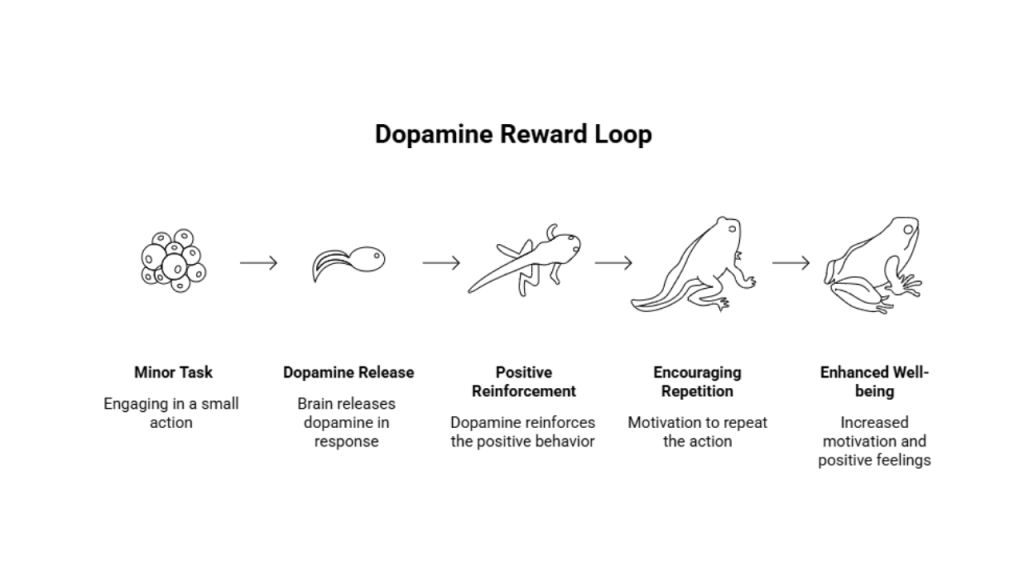
In behavioural psychology, reinforcement is anything that increases the likelihood of a behaviour being repeated. When you complete a small action and feel even a tiny sense of satisfaction, your brain releases dopamine — the molecule of motivation and reward. Here’s the catch: your brain doesn’t distinguish between a micro win and a mega win. It just registers: action taken → reward received → do it again.
B.F. Skinner’s foundational work on operant conditioning showed us that frequent, smaller reinforcements are actually more powerful for behaviour change than rare, large ones. This is why slot machines are addictive and why checking off a to-do item feels inexplicably good.
More recently, Harvard researcher Teresa Amabile identified what she called the Progress Principle — the finding that of all the things that can boost a person’s engagement and creativity, the single most important is making progress in meaningful work. Even small incremental progress. The emotional lift from a micro-win ripples outward, increasing motivation, focus, and sense of capability.
What Are Small Wins, Really? They Are Identity Evidence.
Here’s the reframe that changes everything.
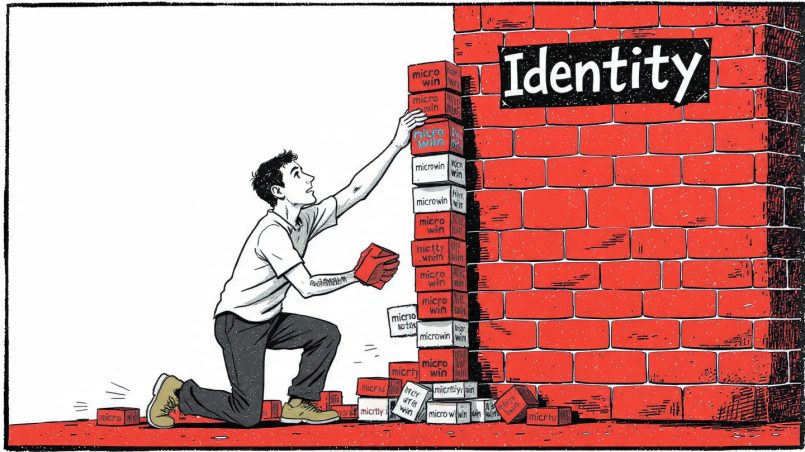
Every small win is not just a task completed. It is evidence. It’s a data point you’re adding to the file your brain keeps of who you are.
Think about it this way. If someone asked you, “Are you a disciplined person?”, you’d answer based on your mental collection of evidence. You’d scroll through memories: did I show up? Did I follow through? Did I do the hard thing when I didn’t feel like it?
Every small win you take seriously goes into that file. Every small win you dismiss gets shredded. Over time, the file either grows thick with proof or it stays empty. You keep wondering why you don’t believe in yourself.
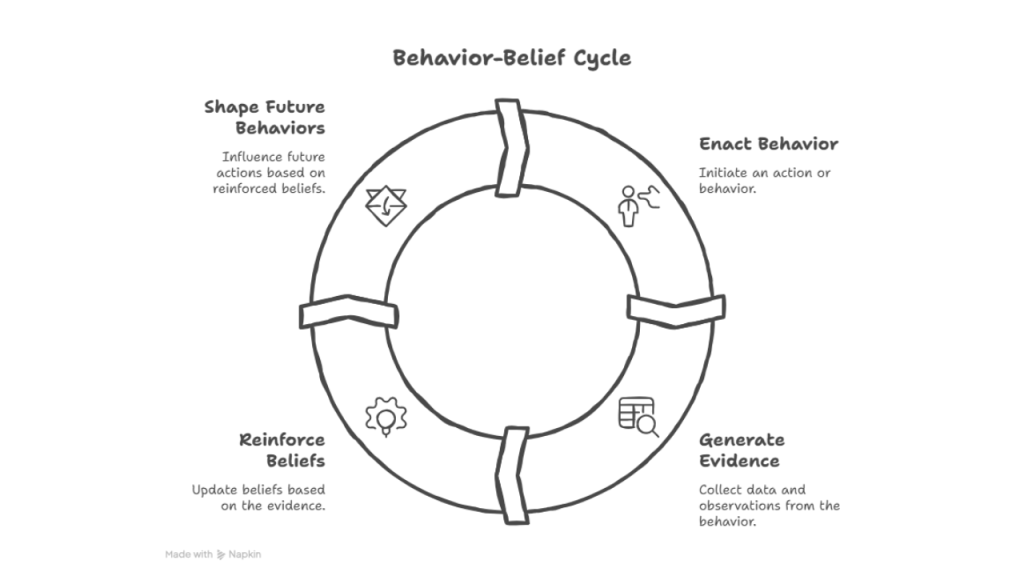
This is the Identity Reinforcement Loop: behaviour creates evidence, evidence shapes belief, belief drives behaviour. Dismiss the behaviour, and you break the loop.
The Compounding Effect of Micro Wins
JJames Clear, in Atomic Habits, made a now-famous calculation: if you get 1% better every day for a year, you end up 37 times better by the end of it. That’s not motivational math — that’s actual exponential compounding.
But here’s what most people miss: the compounding isn’t just about skill or output. It compounds identity. Each small win tells you something about who you are. Repeated enough, it stops being a win and starts being just what you do. It becomes part of you.
Darren Hardy calls this the Compound Effect — the principle that small, consistent choices seem insignificant in the moment but create massive results over time. The terrifying flip side? Small negligences compound too. Skipping the gym once is fine. Telling yourself it doesn’t matter is what creates the habit of quitting.
Why Consistency Beats Intensity (Every Single Time)
Be honest: how many times have you gone hard for two weeks and then burned out? Intensity is exciting. It feels productive. It makes for a good Instagram caption. But it is the worst strategy for long-term change.
Here’s why consistency wins:
| Intensity | Consistency |
| Feels powerful in the moment | Builds power over time |
| Relies on motivation and energy | Works even on bad days |
| Creates boom-bust cycles | Creates steady upward momentum |
| Makes you feel like a hero for a week | Makes you feel like yourself forever |
| Hard to maintain after life disruptions | Adaptable — even 5 minutes counts |
BJ Fogg, Stanford behaviour scientist and author of Tiny Habits, spent years studying what actually makes habits stick. His conclusion? Make it tiny, anchor it to something you already do, and celebrate every single time. The celebration, even a mental fist pump, is the reinforcement that wires the behavior in.
Real Examples of Small Evidence Loops
Let’s make this concrete. Here are small wins that are, in reality, massive identity evidence:
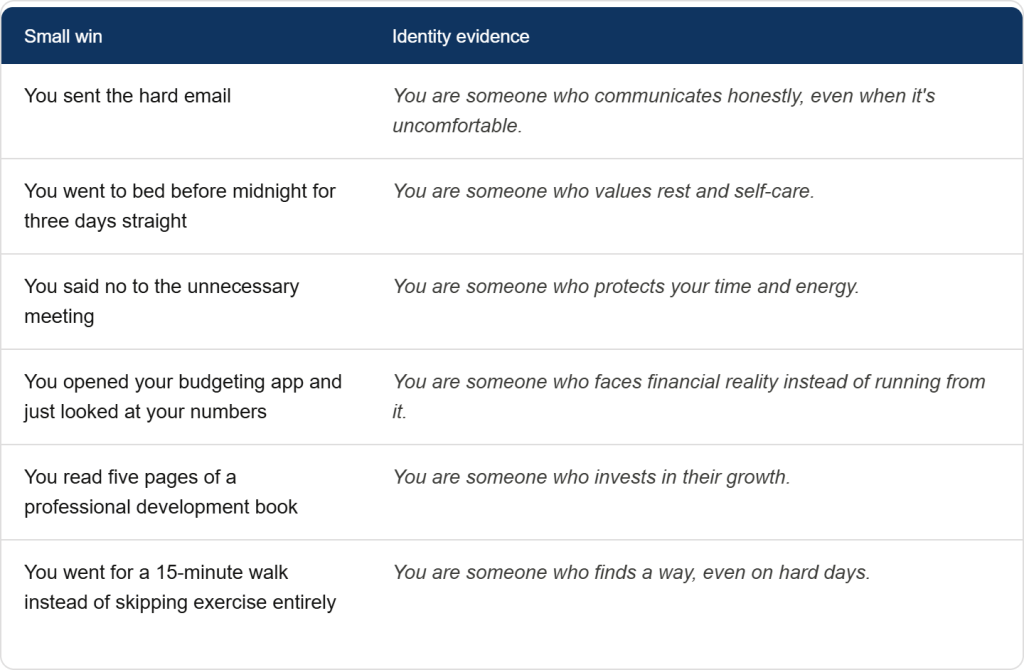
Step-by-Step: How to Start Treating Small Wins as Identity Evidence
Here’s your practical roadmap. You don’t need a life overhaul. You need a new lens.
- Name the win out loud (or in writing). Don’t let it pass silently. Say it. Write it. “I did that. “Simple. Powerful.
- Link it to identity, not just achievement. Instead of “I worked out today”, try “I am someone who moves their body.” This is the language of identity formation.
- Track it visually. Use a habit tracker app like Habitica, Streaks, or even a paper calendar. Seeing the chain of X’s creates is dopamine fuel.
- Celebrate immediately. Your brain needs a signal that the win happened. Nodding, a smile, a quick note. The bigger you make the pause, the more it whirs.
- Review weekly. Look back at your small wins. Notice the pattern emerging. That pattern is your new identity taking shape.
- Share it with someone who gets it. Accountability partners amplify wins. Even a quick text, “I did the thing,” reinforces the loop through social connection.
The Weekly Identity Tracking Method
Once a week, Sunday evening works well for most professionals – sit down with your journal or a simple notes app and answer three questions:
- What are three small wins I had this week?
- What do these wins say about who I am becoming?
- What is one tiny action I will take next week to add more evidence?
That’s it. Ten minutes, three questions, massive clarity. Over time, you’ll look back at weeks, months, and years of entries and see someone you barely recognise in the best possible way.
Frequently Asked Questions
Why do people dismiss small progress?
We’re wired to compare and to chase visible, dramatic results. Social media amplifies this by showcasing only peak moments. We’ve also been culturally taught that effort only counts when it’s epic. The fix is intentionally recalibrating your measurement system and starting to track evidence, not performance.
How do micro wins compound into big change?
Each micro win reinforces a neural pathway. The behaviour becomes more automatic. Your self-belief grows. You take slightly bigger actions. Those actions compound over months and years into outcomes that look, from the outside, like overnight success. The compounding isn’t always visible in real time, but it’s always happening.
What’s the psychology behind small-win reinforcement?
It comes down to dopamine and operant conditioning. When you complete an action and acknowledge it, your brain rewards you with a small hit of dopamine. This reinforces the behaviour, making it more likely to repeat. Frequent small rewards are actually more powerful for habit formation than rare large ones.
Does consistency beat intensity for habits?
Yes — and the research is clear on this. Intensity creates early results but is unsustainable. Consistency builds identity-level change. Even small, imperfect actions done regularly beat big, perfect actions done sporadically. When life gets messy (and it will), consistency is what keeps the thread.
What are real examples of identity evidence from small wins?
Reading five pages. Sending the difficult message. Logging one meal. Taking a 10-minute walk. Saying “no” to something that didn’t serve you. Each of these is a vote cast for the person you’re choosing to become, as James Clear would put it.
How do I start weekly identity tracking?
Start simple: every Sunday, write down three small wins from the week and one sentence connecting each win to your identity. You can use a notebook, Notion, or any app. The consistency of doing this weekly matters far more than having the perfect system.
What are the most common mistakes when ignoring small wins?
The biggest mistake is the binary trap — believing that unless it was perfect or complete, it didn’t count. Other common mistakes include comparing your early-stage small wins to someone else’s mature results, tracking outputs instead of behaviours, and waiting to feel proud until you’ve “really earned it”.
Try This Right Now: The 3-Win Reset
Pull out your phone or grab a pen. Think about the last 48 hours. Write down three things you did — no matter how small — that reflect a version of you you’re proud of.
- I ____________, which means I am someone who ____________.
- I ____________, which means I am someone who ____________.
- I ____________, which means I am someone who ____________.
Read it back. That person you just described? That’s already you. The wins are already in your file. Now add to it.
Resources to Build Your Small Win Practice
These tools and books will deepen your understanding and give you practical systems for reinforcing your identity through small wins:
| Resource | Why It Helps | Type |
| Atomic Habits by James Clear | The definitive guide to identity-based habit change through small wins | Book |
| Tiny Habits by BJ Fogg | Stanford-designed system for anchoring micro behaviors to build evidence | Book |
| The Compound Effect by Darren Hardy | Shows how daily micro choices create massive long-term outcomes | Book |
| Habitica | Gamified habit tracker turning small wins into RPG-style rewards | App |
| Streaks (iOS) | Simple streak-builder to log and celebrate daily consistency | App |
| Notion Habit Tracker Template | Customizable weekly tracker for identity evidence logging | Template |
| Fabulous App | Science-backed guided journeys for micro habits and reinforcement | App |
| High Performance Habits by Brendon Burchard | Research-based system for consistent identity evidence building | Book |
The File Is Already Building
Here is the truth I want you to sit with.
You didn’t need this post to start collecting evidence.
You’ve been collecting it all along.
Every kept promise. An uncomfortable action is completed. Every time you showed up when you could have quietly disappeared.
It’s all in the file.
The only question is whether you’re counting it.
Stop shredding your evidence.
One small win, counted deliberately, does more for your identity than ten wins you dismissed.
That’s how the loop turns.
This Week’s Question
What’s one small win you almost didn’t count this week?
Drop it in the comments. Name it out loud.
Because once you say it, it’s in the file.
Identity Reinforcement Loop Series
Post:
1: Identity Reinforcement Loop: Self-Image
2: Small Behaviours Change Your Identity
3: The Stories You Tell Yourself Are Programming Your Life
4: Small Wins Are Not Small: They Are Identity Evidence — You Are Here
Affiliate Disclaimer: Some of the links on this website are affiliate links. This means that if you click on a link and make a purchase, I may receive a small commission at no additional cost to you.