Comparison will convince you that you’re running late. But you can’t be late to a race that only you are running.
Please sit with that for a second, because I know why you’re here. It’s 11pm, the group chat has gone quiet, and you’re scrolling through a version of everyone else’s life that looks suspiciously more finished than yours. Someone from matric got promoted. Someone posted a house deposit, someone’s “living their purpose” in a caption under a sunset, and you’re lying in your childhood bedroom wondering when your life was supposed to start.
Here’s the thing nobody tells you: that feeling, the tight, panicky one that says I should be further by now, isn’t proof that you’re behind. It’s proof that you’re comparing a behind-the-scenes cut of your life to somebody else’s highlight reel. And highlight reels don’t have timelines. They have edits.
The Comparison Trap: How “Behind” Freezes Potential
Comparison doesn’t just sting — it stalls you. Psychologists call it social comparison, but you don’t need the textbook definition to know how it feels. It feels like standing at the start line, watching everyone else already running, and deciding the smartest move is not to run at all. Why bother if you’ve already “lost”?
That’s the trap. Comparison convinces you the race is real, the finish line is fixed, and everyone’s on the same track. None of that is true. Your cousin’s engineering degree, your friend’s fintech job, your classmate’s growing following — those are their laps on their track, timed by their own clock. You were never in that race. You’re building something else entirely: a life that’s actually yours, which means it was never going to look like theirs.

The danger of the comparison trap isn’t just feeling bad for an evening. It’s what it does over time — it freezes potential. When you’re constantly measuring your chapter one against someone else’s chapter ten, you stop taking the small, unglamorous actions that would actually move you forward. Why post the first shaky video?, Or why apply for the internship you’re only 60% qualified for? Why start the thing at all if starting means looking behind before you’ve even begun?
The South African Lens: Why “Behind” Hits Different Here
Let’s be honest about where we’re standing. If you grew up in South Africa, “behind” was practically installed in you before you understood the word.
- Matric pressure. From Grade 10, you were told your final exam results would determine the rest of your life—university, career, and worth. Nobody mentioned that plenty of successful adults barely scraped through matric, wrote it more than once, or didn’t write it at all.
- The unemployment numbers are brutal, and they’re not your fault (see the table below). If you’re unemployed right now, you are not the outlier — you are the statistical majority. That changes the story you tell yourself about why you “haven’t made it yet”.
- Family expectations. In a lot of our homes, especially where a whole family invested in one child’s education, there’s an unspoken invoice attached to your future: we sacrificed; now perform. That’s heavy to carry into your twenties, and it’s easy to mistake it for your own definition of success.
- The WhatsApp status economy. Every family group chat, every “so what are you doing now?” at a funeral or a braai, every cousin’s engagement post — it’s a constant, low-grade broadcast of everyone else’s milestones. It’s not malicious. It’s just loud. And loud things drown out your own timeline if you let them.
| Measure (Stats SA, Q1 2026) | Figure |
| Youth unemployment, ages 15–34 | ~45.8% |
| Youth unemployment, ages 15–24 | ~60.9% |
| Young people (15–24) not in employment, education or training | ~37.6% |
None of these pressures are imaginary. They’re real and structural, and they weigh differently on South African twenty-somethings than the influencers you’re comparing yourself to. Which is exactly why using someone else’s timeline — especially one shaped by different resources, different starting points, different everything — was never a fair measuring stick to begin with.
Real Talk: Your Purpose Questions, Answered
Let’s get practical, because clarity isn’t a vibe – it’s a set of questions you actually answer.
What does it mean to have clarity in your life’s purpose?
It’s not a single sentence you discover in a lightning-bolt moment. Clarity in your life purpose means you understand, in plain language, what you value, what problems you’re drawn to solving, and what kind of impact you want your daily actions to add up to. It’s less “aha” and more “oh, that’s been true the whole time.”
How do I know if I’ve found my true life purpose?
You’ll notice it less as a feeling and more as a pattern — the work doesn’t drain you the way other things do, even on hard days. You’d choose it again if you started over. That’s usually a stronger signal than excitement, because excitement fades and this doesn’t.
What are practical steps to find clarity in my life’s purpose?
Start smaller than you think. Write down three moments in the last year when you felt genuinely useful or alive. Look for the thread. Then test it — take one small, visible action this week that moves toward that thread, instead of waiting for the whole picture to arrive first.
Can I have more than one life purpose, or just one?
You can absolutely have more than one. Purpose isn’t a single job title; it’s a direction, and directions can hold multiple expressions – a career, a side project, how you parent, how you show up for your community.
What’s the difference between life purpose, career, and passion?
Passion is what excites you. Career is how you currently earn. Purpose is why any of it matters to you. They can overlap, but purpose is the only one of the three that doesn’t disappear when the job changes or the excitement fades.
How do I find clarity in my purpose when I feel lost or stuck?
Stop trying to think your way to an answer and start acting your way there. Clarity is usually downstream of small experiments, not upstream of them. Try one new thing; notice how it felt; adjust; repeat.
What role do values play in discovering my life purpose?
Values are the compass; purpose is the direction it points to. Get the values wrong, and even a “successful” life will feel hollow, because you’ll have built it on someone else’s definition of what matters.
How long does it take to get clear on my life purpose?
Longer than the internet wants you to believe, and that’s fine. This isn’t a weekend project. Think seasons, not weekends – and know that clarity deepens rather than arriving once and staying fixed forever.
Do I need a coach, course, or retreat to find my purpose, or can I do it alone?
You can absolutely start alone — most clarity work is just consistent, honest reflection plus small action. Structured support (a coach, a course, a community) speeds things up and keeps you accountable, but it’s an accelerant, not a requirement.
The Direction-Finding Framework: Values, Vision, First Step
Here’s the framework I’d want you to actually use, not just read.
| Stage | The Question You Ask | What It Gives You |
| 1. Values | What do I refuse to compromise on, even under pressure? | Your compass — decisions stay consistent even when circumstances change |
| 2. Vision | If nobody were watching or judging, what would I be building in five years? | A direction to walk toward, not a deadline to panic about |
| 3. First Visible Step | What’s the smallest action I can take this week that proves this is real? | Momentum — evidence that becomes the foundation for the next step |
This is the same logic behind the Identity Reinforcement Loop: your self-image shapes your behaviour, your behaviour creates evidence, and that evidence reinforces (or rewrites) your self-image. If you keep telling yourself you’re “behind,” you’ll keep acting in ways that confirm it — hesitating, comparing, waiting for permission. But take one small, visible step in the direction of your values, and you generate different evidence. Evidence that says: I am someone who starts. I am someone who’s building.

You don’t need a five-year vision mapped out before you’re allowed to move. You need the next visible step. That’s it. That’s the whole unlock.
Ten Things True About You That Are Actually Advantages
Say these are true, because they are:
- You’re starting later than the algorithm says you should — which means you’re starting with more self-awareness than someone who rushed in blind.
- You’ve survived a labour market that breaks people twice your age – that’s resilience, not failure.
- You know what struggle looks like up close, which makes you far harder to fool with a shortcut.
- You grew up multilingual, code-switching between worlds — that’s a communication skill most people pay thousands to learn.
- You understand community economics, stokvels, and shared resources – informal systems most business schools don’t teach.
- Your “slow start” means you’ll build on a foundation, not a trend, which is exactly why it’ll last.
- You’ve had to be resourceful with less, which means you waste less when you finally have more.
- You’re digitally fluent in a way that opens continental and global doors your parents’ generation never had.
- You’re young enough that “too late” is a lie your brain is telling you, not a fact about your life.
- You’re still here, still reading this, still asking the questions — and that, more than anything else on this list, is the actual advantage.
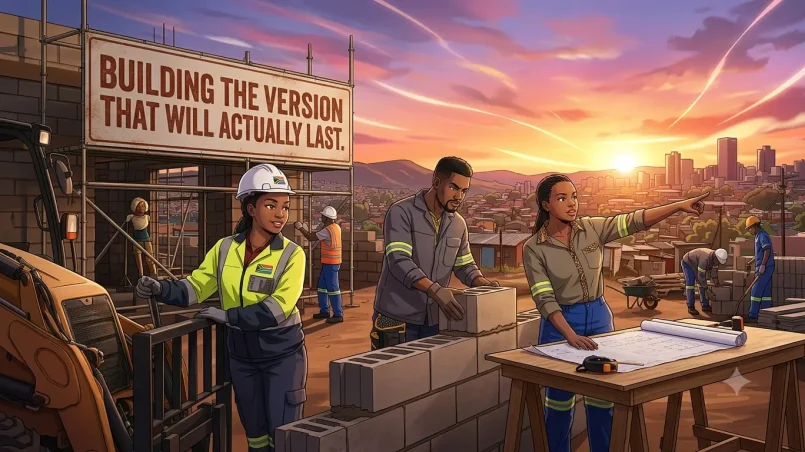
You’re Not Behind — You’re Building the Version That Lasts
Nobody who’s built something that actually holds up did it on someone else’s timeline. The version of you that’s rushed into existence to keep pace with a comparison you never agreed to is the version that cracks the first time life gets hard. The version built slowly on your own values, with your own first steps — that’s the one that lasts.
You’re not behind. You’re laying foundation. And foundations, by design, take longer than the walls everyone else is already showing off.
Your Next Visible Step
Ready to actually build it, step by step? Join the Life Coaching Animated WhatsApp channel for weekly drops on identity, direction, and momentum — no fluff, just the next visible step. And if you’re ready to go deeper, keep an eye out: Skill to Scale, our upcoming course built on this exact framework, is coming to help you turn clarity into a real, sustainable income – on your terms, on your timeline.
Rebuild the Person Who Can Build the Future Series:
- You Can’t Build a New Future With an Old Version of Yourself
- How Self-Perception Shapes Success More Than Talent
- Your Feelings Are Real. But They Don’t Get to Be in Charge
- Mindset Shift Consistency: The Boring Season
- You Need to Trust Yourself First — Here’s How to Earn It
- You’re Just Building the Version That Will Actually Last..- You Are Here