You had the plan. You were going to stay quiet in that meeting. Send the calm text. Walk away from the argument with your mother before it turns into the same fight it always does.
Then the moment came. Someone said the wrong thing. Your phone buzzed with news you weren’t ready for. And the plan? Gone. It seems you reacted before you even knew you were reacting.
Sound familiar?
Here’s the thing nobody tells you about emotions: they’re not the enemy. Anger is information. Fear is information. Even that heavy, directionless sadness that sits on your chest on a Tuesday afternoon — it’s telling you something true.
But information isn’t instruction. Your feelings are allowed to show up. They are not allowed to drive.
That’s the whole idea behind emotional self-control, and it’s the difference between a life that happens to you and a life you actually build.
The Gap Between Feeling and Deciding
Let’s define it properly, because most people get this wrong.
Emotional self-control – sometimes called “emotional regulation” or “emotional intelligence in action” – is your ability to notice what you’re feeling without letting that feeling make your next move for you. It’s not about feeling less. It’s about deciding more.
Between the trigger and your reaction, there is a gap. It might only last half a second right now. But that gap is where every choice you’ve ever respected — in yourself or anyone else — actually lives.
Most people never find that gap. They go from spark to explosion in one smooth motion, then spend the rest of the day cleaning up a mess their feelings made. That’s just poor self-regulation, and it’s rarely about being a “bad person”. It’s usually about never being taught how to widen the gap.
Here’s the part that matters for how you see yourself: every time you react instead of respond, you’re not just making a bad choice in the moment. You’re teaching your own brain that this is who you are — the person who blows up, who shuts down, who can’t handle pressure. And your brain believes what you show it. Feed it enough reactive moments, and it starts calling that “personality”. Feed it evidence of a pause instead, and it starts calling that “you” too.

Why This Hits Different Here
Let’s be honest about something the international self-help content skips over.
Staying calm is a different exercise when you’re carrying collective stress — when your emotional load isn’t just your bad day, it’s your family’s finances, your friend’s crisis, and the pressure of being the one who “made it out” and now has to hold everyone up. Township economies run on tight margins and tighter nerves. Money stress doesn’t stay in its lane; it shows up as short tempers at the dinner table, at taxi ranks, and in group chats that go quiet after one message too many.
And family dynamics here often come with an unspoken rule: keep the peace; don’t embarrass the house; respect is non-negotiable even when you’re the one hurting. So a lot of us learned to either explode in private or swallow everything in public. Neither one is emotional self-control. One is suppression, wearing a mask; the other is a delayed explosion, waiting for the wrong moment to land.
Real emotional regulation isn’t about becoming numb so you “fit in” with the calm. It’s about staying present to what you feel while choosing, on purpose, how you let it move through you.
What Poor Emotional Self-Control Actually Costs You
Before the fix, be honest about the price.
Poor emotional self-control usually comes from a mix of causes: unprocessed stress, exhaustion, low self-awareness, unhealed experiences, and — this one’s underrated — never having a model for it growing up. You can’t practise a skill nobody showed you.
The cost shows up quietly at first:
- Friendships that get strained by one too many outbursts
- Opportunities lost because you reacted to feedback instead of hearing it
- A relationship with yourself built on regret — the “why did I say that” spiral
- Physical symptoms: tension, poor sleep, that constant background hum of stress
Signs of strong emotional self-control look almost boring by comparison. You pause before responding, and hear criticism without collapsing or attacking. You recover from a bad moment in minutes, not days. None of that is flashy. All of it is powerful.
The 3-Step Emotional Pause
This is the move. Simple enough to use in a taxi, in a meeting, or mid-argument.
Step 1 — Name it. Silently, in your head: “I am feeling ___.” Not, “This person is ridiculous,” or Everything is falling apart. “Just the feeling, named plainly. Anger. Panic. Shame. Naming an emotion cuts its intensity almost immediately — your brain processes a labelled feeling differently from a formless one.
Step 2 — Locate it. Where is it sitting in your body? Chest, jaw, stomach, fists? Give it three seconds of attention. This does two things: it interrupts the automatic reaction loop, and it reminds you that a feeling is a physical event that will pass, not a permanent verdict on your life.
Step 3 — Choose the next sentence. Not the next hour, or the whole conversation. Just the next sentence or the next action. “I need a minute.” “Let me think about that.” Even silence. You’re not solving the whole moment — you’re just refusing to let the feeling write your line for you.
Three steps. A few seconds. Practised enough times, this becomes the gap you couldn’t find before.

Know Your Triggers Before They Know You
You can’t pause for something you don’t see coming. So do this exercise properly — grab a notebook or your notes app and get specific.
| Your Trigger | What It Usually Sounds Like | The Feeling Underneath |
|---|---|---|
| Being interrupted | “You’re not listening to me.” | Disrespect, invisibility |
| Money pressure | “There’s never enough.” | Fear, shame |
| Being compared | “Why can’t you be more like—” | Inadequacy, resentment |
Fill in your real top three. Most people, when they finally sit down and do this, realise their “random” outbursts aren’t random at all. They’re the same three triggers, dressed differently, showing up on repeat. That’s not a character flaw. That’s just data you finally collected.
Mindfulness helps here too — not the incense-and-silence version, just the practice of checking in with yourself a few times a day. “What am I feeling right now?” asked consistently, building the exact muscle this whole thing depends on.
At work, in relationships, the principle doesn’t change. Know the trigger, use the pause, choose the sentence. It’s the same three steps whether it’s a difficult boss or a difficult partner.
Is This the Same as Suppressing Your Feelings?
No — and this distinction matters more than almost anything else in this post.
Suppression says: don’t feel it. Emotional self-control says, “Feel it fully, then choose your response on purpose.” Suppression builds up pressure that leaks out sideways later, usually on someone who didn’t deserve it. Regulation lets the feeling move through you and out without it steering the wheel on the way.
If you’ve been told you’re “too emotional”, the goal was never to become someone who feels nothing. It’s to become someone whose feelings inform their next move instead of hijacking it. Yes, this can be learnt — at any age, with practice, the same way any skill sharpens with reps.
A workbook or journal built around identifying triggers and tracking patterns can genuinely speed this up if you want something structured to work through. But the core tool costs nothing: name it, locate it, and choose the next sentence.
Quick-Fire Techniques for When You Don’t Have Time to Journal
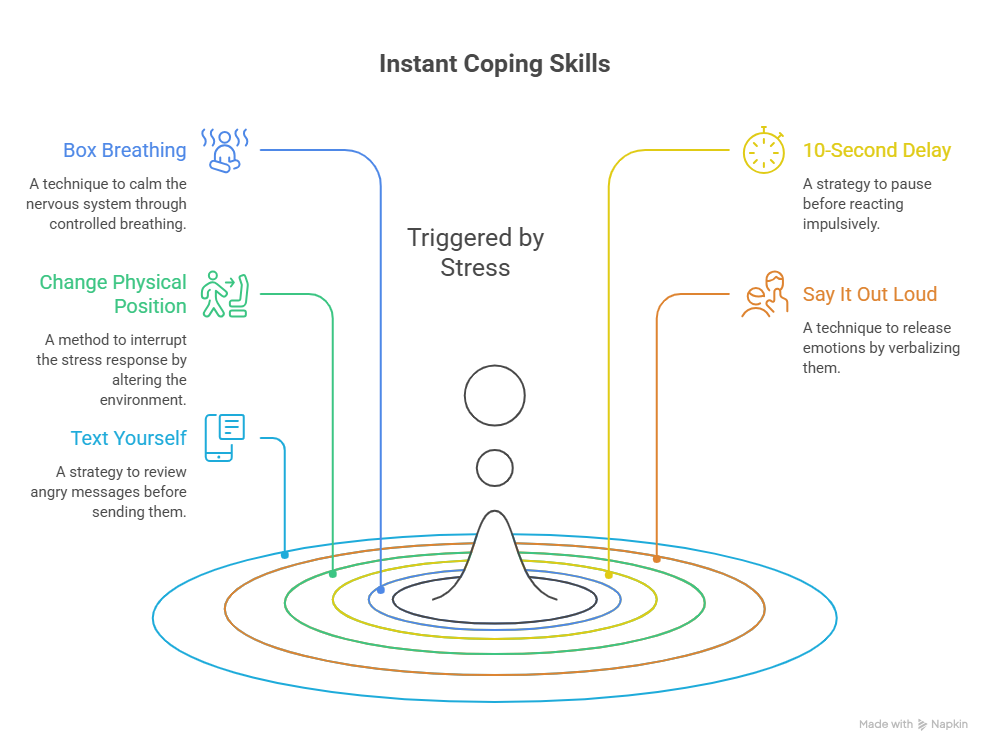
None of these are complicated. That’s the point. Stress management doesn’t need to be sophisticated to work — it needs to be available in the moment you actually need it, not just in the calm after.
Your Move
Here’s the truth this whole post has been circling: you are not your worst reaction. But you also don’t get to keep blaming your feelings for choices that were, if we’re honest, still choices.
Your feelings are real. They deserve to be heard. They do not deserve the keys.
Name your top trigger. Practise the pause the next time it shows up — today, not “one day.” Then come tell us about it.
Join the Life Coaching Animated WhatsApp channel, drop your trigger in the chat, and own your response out loud.
That’s how the shift actually starts — not in theory; in the next moment, you catch yourself before you react.
Rebuild the Person Who Can Build the Future Series:
- You Can’t Build a New Future With an Old Version of Yourself
- How Self-Perception Shapes Success More Than Talent
- Your Feelings Are Real. But They Don’t Get to Be in Charge. — You Are Here