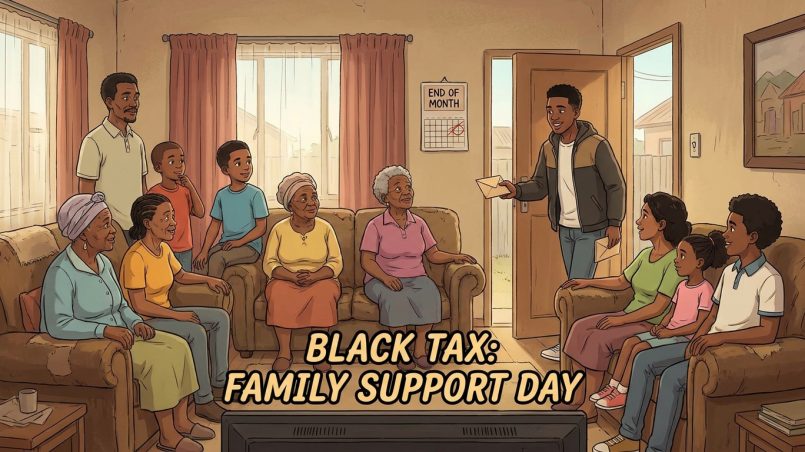
You never signed it. You have been paying it since your first salary.
It’s the 25th. The money lands.
Before you’ve checked the balance, a message comes in. A school fee. A burst geyser. Someone’s transport. Someone’s “just until month end”.
You send it. You always send it. Then you stand in the queue at the till with what’s left, doing maths you’ve done a hundred times.
I have seen this up close. I have heard it from colleagues more than once.
They haven’t even touched their money, and family and friends are already asking for it.
Most of them never worked out a budget. So everyone else’s needs get to the money first.
“It’s not fair.” That’s the line, usually said with real disappointment.
Then they give anyway. They give to end the argument. Paying is cheaper than fighting over their own money.
Nobody sat you down and read you the terms. Nobody asked if you agreed.
But the contract exists. It has clauses, a payment schedule, and no end date.
I call it The Silent Contract.
What Is the Silent Contract?

Last week, Payday Is a Mirror showed you what your reaction to money reveals. This week we look at who else is already on the payslip.
The Silent Contract is the set of unwritten financial obligations your family, community, or culture placed on you before you could say yes or no. Black tax is its most recognised form in South Africa.
Every Silent Contract has three parts.
1. The Terms
The Terms are what everyone assumes you owe. Not what was agreed. What was assumed?
You are the first one with a salary. The first one to matriculate. The first one with a bank card that doesn’t bounce.
So the Terms write themselves. Pay for this. Cover that. Be there when it breaks.
In Week 1, you met the Rule — the inherited belief that drives your Reaction. The Terms are that Rule with a rand sign on it.
2. The Payments
The Payments are what actually leave your account, your time, and your peace.
Most people can’t tell you the number. That is the whole problem.
An R400 here. A R1,200 there. A taxi fare. A data bundle. A “borrow” that never comes back.
None of it feels big on the day. Added up across a year, it is rent. Sometimes it is a deposit on a house you never get to buy.
3. The Renewal
The Renewal is how the contract extends itself.
Every payday, the Terms renew automatically, because nobody ever cancelled, adjusted, or even named them.
Silence is the signature. Every month you say nothing, you re-sign.
Silent Contract vs Written Agreement
| Silent Contract | Written Agreement | |
| Terms | Assumed, never spoken | Stated out loud, in plain words |
| Amount | “Whatever is needed” | A number you chose |
| End date | Never | A review date |
| Who knows? | You, quietly | Everyone involved |
| Pushback feels like | Betrayal | A normal conversation |
| What it protects | The family’s image of you | The family and your future |
Why This Hits Harder in South Africa
Ubuntu is real. It is one of the best things we have.
I am because we are. A community that carries its own. That principle kept people alive through apartheid, evictions, and retrenchments.
But Ubuntu was mutual and visible. The whole street knew who gave what, and the whole street gave.
Somewhere between the principle and the pay cycle, a quieter version took over. One person gives. Nobody says how much. Nobody asks how it’s going.
Here is how that looks across the lives we serve:
- The floor worker sends a third of a wage home and still gets called “the one who made it”.
- The graduate lands the first real salary and inherits a household’s backlog in the same month.
- The hustler running a chair, a stall, or a spaza shop gets treated like a bank because cash is visible and the bills are not.
- The professional funds two households on one salary and never mentions it at work.
Then add the realities that make saying no feel impossible: funerals that cost more than a month’s pay, stokvel contributions, load-shedding emergencies, and school fees due on a Friday.
Cape Flats, township, suburb. The names change. In some families it is “black tax”; in others it is “family comes first”. The Silent Contract does not check your postcode.
And it does not need your family to be bad people. Most of them aren’t. They are running their own inherited Rule, and you are the one who made it out.
The Move: Rewrite the Contract
This is Week 3’s assignment. Do it in one sitting, with a pen.
- Write the Terms. On paper, list every person you support and what you pay for them. Include the “small” things. Include the time.
- Price the Payments. Add up the last three months. Monthly total in rand. Look at the number for a full minute before you do anything else.
- Split obligation from emergency. Mark each item as regular (predictable, every month) or emergency (sudden, once-off). Regular items get a budget line. Emergencies get a separate fund.
- Set a ceiling, and budget it before payday. Choose a monthly amount for family support that you can sustain for five years. Not for five months. Five years. Put it in your budget before the money lands, so when the messages start, the answer is a number you already decided, not a mood you’re guilty about.
- Say the terms out loud to one person. One. The family member you trust most, or the one who receives the most. Tell them the number and the date it’s reviewed.
- Set the Renewal date. Put a review in your calendar every three months. The contract stays alive, but now you are the one holding the pen.
If step 5 scares you, that tells you how much power the silence has had.
The Part Nobody Wants to Hear

Giving less, on purpose, keeps you giving longer.
The silent version of Black Tax usually ends one of two ways. You burn out and cut everyone off in one angry month. Or you stay quiet for twenty years and resent people you love.
A ceiling prevents both. It lets you stay generous without going bankrupt in the process.
And a named amount protects the receiver too. Someone who knows R1,500 comes every month can plan around it. Someone who gets random R3,000 bursts and long silences cannot.
Boundaries are how a contract survives. Without them, it breaks.
FAQs
What is black tax?
Black tax is the financial support many Black South African professionals give to extended family, often parents, siblings, and relatives, because they are the first in the family with a stable income. Its roots are in the economic exclusion families lived through for generations.
Is black tax a South African thing only?
No. The pattern appears across Africa and in immigrant and working-class families worldwide, under different names. The Silent Contract is the same structure wherever it shows up.
Is it wrong to send money home?
No. Supporting your family is a value worth keeping. The problem starts when the support has no number, no limit, and no conversation attached.
How much of my salary should go to family?
There is no universal percentage. The right amount is one you can sustain for years without borrowing, missing your own basics, or resenting the people you’re supporting. Work it out from your Payments total in The Move.
How do I tell my family I need to set a limit?
Start with one person, in private, and lead with what you can commit to, not what you are cutting. Give a number and a review date. Keep it short.
What do I say when people ask before I’ve even been paid?
Tell them the amount is already planned. “My family budget is set for this month. I can look at it again on the review date.” You are not refusing. You are pointing to a number that exists.
Will setting a boundary make me selfish?
It will feel that way, because the Terms taught you that your needs come last. Feeling guilty does not mean you are doing something wrong. It means the contract is being edited.
What if my family depends on me completely?
Then a clear ceiling matters even more. If you collapse financially, everyone who depends on you goes down with you. Start by separating regular needs from emergencies so you know what you are actually covering.
How do I handle emergencies, like funerals or hospital bills?
Build a small emergency pot just for family crises, even R200 a month. When a crisis hits, you answer from the pot instead of from your rent.
What if I earn less than my family thinks I do?
Share your real situation with the one person from The Move. People guess high when they only see your phone, your clothes, or your job title. Honest numbers correct the guessing.
Can I save and still support my family?
Yes, if the support has a line in your budget and the savings come out first or at the same time. If savings only get what’s left after the family, there will never be anything left.
How do I stop lending money that never comes back?
Decide in advance whether a “loan” is a gift. If you can’t afford to lose it, say so. If you can, give it as a gift and let the guilt around repayment go.
Does this apply if I’m a student on a bursary or doing piece jobs?
Yes. The Silent Contract starts the moment people see you as someone with access to money, however small. The Move works at any income, including R800 a month.
What if my partner and I disagree about supporting family?
Bring your written Terms and Payments to the conversation. You are both dealing with two sets of inherited Rules. Numbers on paper turn an emotional argument into a planning conversation.
Where do I start if this feels overwhelming?
Step 1 of The Move. Write the list. Don’t change anything yet. Naming the contract is the first edit.
Resources to Rewrite the Contract

| Resource | What it does for The Move |
| A plain notebook | Steps 1 to 3 on paper. Pen and paper make the numbers real in a way a phone does not. |
| A separate “family” account or savings pocket | Gives step 4’s ceiling a physical home. When the pot is empty, the answer is “next month.” |
| A small emergency pot (R200 to start) | Handles funerals and hospital bills without touching rent. |
| Free R500 Startup Guide | For when the real squeeze is that not enough comes in. Five low-cost business ideas to build income that is yours to budget. |
| Your existing stokvel, if you’re in one | Already a written agreement. Use it as proof that structured giving works. |
Rewrite Your Contract With Us
You can’t edit a contract you’ve never read.
This week, write yours down. One page. Three columns: Terms, Payments, Renewal.

Then join the WhatsApp channel, where Week 4 lands next Monday and where we work through these moves together. Link at the top of the page.
Money You Didn’t Learn At Home Series:
- The Money Rules Nobody Taught You
- Payday Is a Mirror, Not a Moment
- The Silent Contract: Black Tax and the Money You Don’t Get to Keep—You Are Here