(And What to Do About It)
You don’t lose self-trust all at once. It drains, one unkept promise at a time, until you stop believing the person in the mirror.

Picture this: Sunday evening. You’ve got your journal open, gym bag by the door, and a calm, determined look on your face. “This week is different,” you tell yourself. Monday goes well. Tuesday, decent. By Wednesday, something comes up, a late meeting, a mood dip, a Netflix spiral, and the plan quietly collapses. No drama. No grand failure. Just a soft exit.
By Friday, you’re not angry about it. You’re just… numb. And somewhere deep in the background, a little voice notes: “Yeah. I knew you wouldn’t stick with it.”
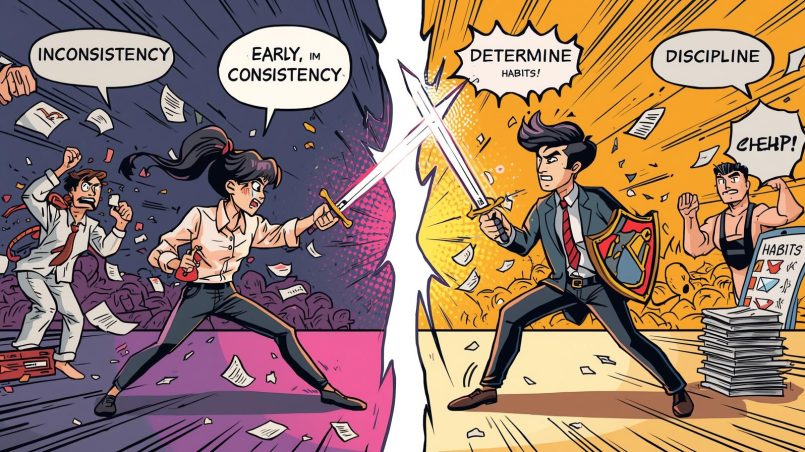
That voice? That’s not your inner critic being dramatic. That’s your self-trust doing an honest audit. And if this pattern keeps repeating in your fitness goals, your career ambitions, your boundaries, your creative projects, that voice gets louder and harder to argue with. Here’s the confronting truth: inconsistency doesn’t just slow your progress. It destroys your confidence from the inside out.
| “Every time you break a promise to yourself, you teach yourself that you can’t be trusted. And you can’t outrun a belief you’ve reinforced a hundred times.” |
The Hidden Cost of Broken Commitments
We talk a lot about discipline and motivation, but we rarely talk about what actually happens neurologically and psychologically when we say we’ll do something, and then don’t. It’s not just a missed workout or an unfinished project. Every broken commitment is a data point your brain files under “things I do.”
Here’s the sneaky thing about self-trust: it doesn’t operate on what you intend to do. It operates on what you actually do, consistently, over time. Your subconscious is keeping a running tab. And when that tab keeps showing up in the red, your whole system starts to doubt the person making the decisions.
Think about it this way. If a colleague kept canceling on you, kept overpromising and underdelivering, you’d stop trusting them, right? Well, you do the same thing to yourself. You start planning around your own commitments because you know, on some level, that you’re not showing up for them.
| Why This Matters for You: Whether you’re a young professional trying to build momentum, someone between jobs rebuilding direction, or a married adult juggling a thousand things. This pattern of inconsistency is one of the quietest and most powerful drains on your self-belief. |
How Inconsistency Damages Self-Trust
Rebuilding self-trust starts with understanding how it gets damaged in the first place. Self-trust isn’t one big thing. It’s made up of thousands of tiny agreements you make with yourself every single day. When you honor those agreements, your confidence compounds. When you don’t, it erodes.
Psychologist Dr. Kristin Neff points out that the relationship you have with yourself mirrors the relationships you have with others. And in any relationship, reliability is the bedrock. Without it, even love starts to fray.
How inconsistency damages self-trust:
- Identity erosion: When your actions don’t match who you say you are, you lose a clear sense of self.
- Decision fatigue on commitments: You start treating your own goals as optional rather than non-negotiable.
- The negativity loop: Each broken commitment triggers self-criticism, which lowers motivation and makes the next commitment harder to keep.
- Paralysis under pressure: Over time, you may stop setting goals altogether, not because you don’t want things, but because failing yourself again feels too painful.
The Psychological Weight of Unfinished Tasks
Have you ever wondered why an unfinished project on a to-do list persists in one’s mind, even when it is not being actively pursued? This phenomenon is formally recognized as the Zeigarnik Effect. Specifically, Russian psychologist Bluma Zeigarnik established that incomplete tasks consume mental bandwidth in a manner that completed tasks do not. Consequently, the brain repeatedly cycles back to these items through persistent cognitive reminders.
Furthermore, when one scales this effect across numerous unfinished commitments—such as a partially completed course, an unlaunched business concept, or a lapsed fitness routine—the result is a cognitive burden analogous to a digital desktop cluttered with excessive open tabs. It’s exhausting. And it eats away at your sense of forward momentum.
This psychological weight contributes directly to something many professionals struggle to name: low-grade, chronic self-doubt. Not the dramatic kind where you question everything. The kind where you quietly hold back, second-guess your instincts, and feel like you’re always slightly behind.
Signs Your Inconsistency Has Started to Hurt Your Confidence
- You set goals with genuine excitement, but feel a familiar dread two weeks in
- Struggle to follow through on things you actually want to do, not just tasks you hate
- Feel like a fraud in your career despite your qualifications
- You have a pattern of people-pleasing because you don’t trust your own judgment
- You make a decision, then immediately question it, over and over
- Find it difficult to celebrate wins because you’re already focused on how you’ll mess up the next thing
The Psychology Behind Why Inconsistency Feels So Damaging
Here’s a simple way to think about it. Your brain is a prediction machine. It learns patterns and then operates on them automatically. When you say “I’m going to do X” and then don’t, you train your brain to predict that you won’t follow through. Over time, that prediction becomes so strong that it fires before you even try, killing motivation before it can get started.
James Clear, author of Atomic Habits, makes the case that every action is a vote for the type of person you want to become. But the reverse is equally true. Every skipped action is a vote for the person you fear you are.
Behavioral science also shows us that when there’s a gap between our stated values and our actions. Psychologists call it cognitive dissonance. We feel genuine discomfort. And to relieve it, we often do something counterproductive: we lower our expectations. We rationalize. The bar drops — and with it, our belief in what we’re capable of.

Rebuilding Self-Trust with Micro-Commitments
The most powerful insight in rebuilding self-trust is also the most counterintuitive one: you don’t need to do more. You need to do smaller. Way smaller. Embarrassingly smaller, if that’s what it takes, actually, to do it.
Micro-commitments are promises so small that breaking them would actually require effort. Want to start exercising consistently? Don’t commit to five days a week. Commit to putting on your gym shoes. That’s it. You’ve kept the promise. Some days you’ll go to the gym. Sometimes you’ll be a person who puts their shoes on, and that’s still a kept commitment.
Here’s why this works: your brain doesn’t distinguish between a “big” promise and a “small” one in terms of how trust gets built. A promise kept is a promise kept. And each one deposits into your self-trust account. Over time, those deposits compound, and that’s when your confidence starts to rise organically, from the inside out.
The Action Framework: Adjust → Act → Finish
Here’s a practical three-part framework for building consistency that actually sticks.
| ADJUST | Before you commit to anything, scale it down until it feels almost too easy. You’re not lowering your ambition, you’re engineering a win. A goal you can actually complete beats a goal that impresses nobody because it never gets started. |
| ACT | Do the small thing. On the hard days, do a smaller version of it. On the days you want to quit, do a symbolic version. The rule is: don’t break the streak unless absolutely necessary. Act first; motivation follows, not the other way around. |
| FINISH | This is the overlooked one. Don’t just start things, complete them, even if they’re tiny. Finish the article. Finish the walk. Completion reinforces the identity: “I am someone who finishes what I start.” That sentence, lived repeatedly, is the foundation of deep, durable self-trust. |
| TRY THIS TODAY — The 5-Minute Self-Trust Reset 1. Write down one micro-commitment for tomorrow — something so small you’d feel embarrassed to skip it. 2. Write down one promise you recently broke to yourself — not to punish yourself, but to acknowledge it with compassion. 3. Write the sentence: “I forgive myself for that, and I’m starting fresh tomorrow.” 4. Tomorrow, keep the micro-commitment. No matter what. 5. Repeat daily. Notice how the voice in your head shifts over 2–3 weeks. |
Frequently Asked Questions
What does rebuilding self-trust actually mean?
Rebuilding self-trust means restoring the inner belief that you will follow through on your own commitments, decisions, and values. It’s not about becoming perfect; it’s about closing the gap between who you say you are and how you actually show up. It happens slowly, through small, consistent actions that prove you are reliable to yourself.
Why have I lost trust in myself?
Self-trust erodes gradually and often through a pattern of over-committing and under-delivering, years of people-pleasing, or trauma that taught you your instincts were wrong. Regardless of why it happened, the path forward looks the same: small acts of integrity, repeated consistently.
How do I start rebuilding self-trust after people-pleasing?
Start by identifying one small area where you can practice honoring your own preference over someone else’s. Over time, choosing yourself in small ways rewires your brain to believe your needs are valid and that belief is the beginning of self-trust.
What are simple exercises to build self-trust?
Keep one small daily promise to yourself, reflect each evening on whether you honored your word, and practice making decisions without immediately seeking external validation. Self-trust journaling prompts like “What did I do today that aligned with who I want to be?” are particularly powerful.
Can therapy help with self-trust issues?
Absolutely. Therapy, especially CBT and self-compassion-based approaches, can help you identify the root causes of your self-doubt and challenge unhelpful patterns. If inconsistency and low self-trust feel deeply ingrained or connected to past trauma, working with a professional is one of the most powerful investments you can make.
How does self-compassion aid self-trust?
Self-compassion removes the shame spiral. Research by Dr. Kristin Neff consistently shows that self-compassion actually increases accountability, not decreases it. You try again faster when you’re kinder to yourself after a stumble.
What role does consistency play in self-trust?
Consistency is the mechanism. Self-trust is the outcome. Every time you do what you said you’d do. No matter how small, you strengthen the neural pathway that says “I can be counted on.” Consistency doesn’t have to be dramatic or perfect. It just has to be real and repeated.
How do I overcome self-doubt to trust myself again?
You can’t think your way out of self-doubt. You have to act your way out. Take one small action that aligns with who you want to be, then notice how it feels. That feeling is evidence. And evidence is more powerful than affirmations.
What daily habits rebuild self-trust?
Making your bed, keeping a “done list” alongside a to-do list, setting one non-negotiable daily intention, and ending the day with a brief reflection: “Did I keep my word to myself today?”
How long does it take to rebuild self-trust?
For many people, the first real shift comes within 2–4 weeks of consistent micro-commitment practice. Deeper self-trust, especially if years of inconsistency or trauma are involved, takes months. You’ll notice the change well before you reach the finish line.
Tools & Resources to Support Your Journey
Hand-picked resources, books, apps, and workbooks that support the work of rebuilding self-trust and overcoming self-doubt. Some links may be affiliate links.
| Product | Type | Best For |
| Atomic Habits — James Clear | Book | Building consistency through small daily habits |
| Daring Greatly — Brené Brown | Book | Vulnerability as a path to self-trust |
| The Body Keeps the Score | Book | Healing self-trust trauma |
| The Self-Trust Journal | Journal | Daily prompts for building consistency |
| Self-Compassion Workbook | Workbook | Practical exercises for trust recovery |
| Boundaries — Henry Cloud | Book | Self-reliance and setting healthy limits |
| Therapy Aid Workbook (CBT) | Workbook | Tackling self-doubt patterns |
| Insight Timer (Premium) | App | Self-trust affirmations & visualizations |
Final Reflection: You Can Trust Yourself Again
Confidence isn’t something you’re born with or permanently lose. It’s something you build steadily, quietly, through the small acts of showing up for yourself even when no one’s watching. Especially then.
The version of you that follows through, that keeps promises even when it’s inconvenient, that finishes things, that person isn’t someone you invent from scratch. They’re already there, waiting for the small proofs that let them step forward.
You don’t need to overhaul your life. You need one small commitment. Then another. Then another. And somewhere between the twentieth and the fiftieth, you’ll notice the voice in the back of your head has changed its tune. Instead of saying “Yeah, I knew you wouldn’t,” it’ll say something you haven’t heard in a while:
“You actually did it.”
That moment, that tiny, private acknowledgment, is where self-trust lives. Go and build it.
| Which identity story are you ready to rewrite? Share this post with someone who needs to hear it. Drop your first micro-commitment in the comments below. |
More from the Identity Reinforcement Loop Series
- Identity Reinforcement Loop: Self-Image
- Small Behaviours Change Your Identity
- The Stories You Tell Yourself Are Programming Your Life
- Small Wins Are Not Small: They Are Identity Evidence
- Why Inconsistency Destroys Confidence — You Are Here
Affiliate Disclaimer: Some of the links on this website are affiliate links. This means that if you click on a link and make a purchase, I may receive a small commission at no additional cost to you.