
Let me ask you something: What was the first thought you had about yourself this morning?
Was it something like, “I’m not a morning person,” or “I always mess things up,“ or maybe “I’m just not good with money”? If any of those hit a little too close to home, that is good. That means we need to talk.
Here’s the thing most personal development content glosses over: you are not just having thoughts. You are shaped by them. Every story you repeat to yourself, whether it’s “I’m not smart enough” or “relationships never work out for me,” is quietly running in the background like an app you forgot to close. And it’s eating up all your processing power.
This isn’t a metaphor. This is neuroscience. And understanding it might be the most important thing you do this year.
Your Brain Is Not a Neutral Recorder — It’s a Story Editor
Here’s where it gets fascinating. Your brain doesn’t just observe your life. It narrates it. Every experience you have gets filtered through a lens of existing beliefs. If you already believe “I’m bad at public speaking,” your brain will highlight every awkward pause, every stumble, every blank stare from the audience — and quietly edit out the nods, the laughs, the applause.
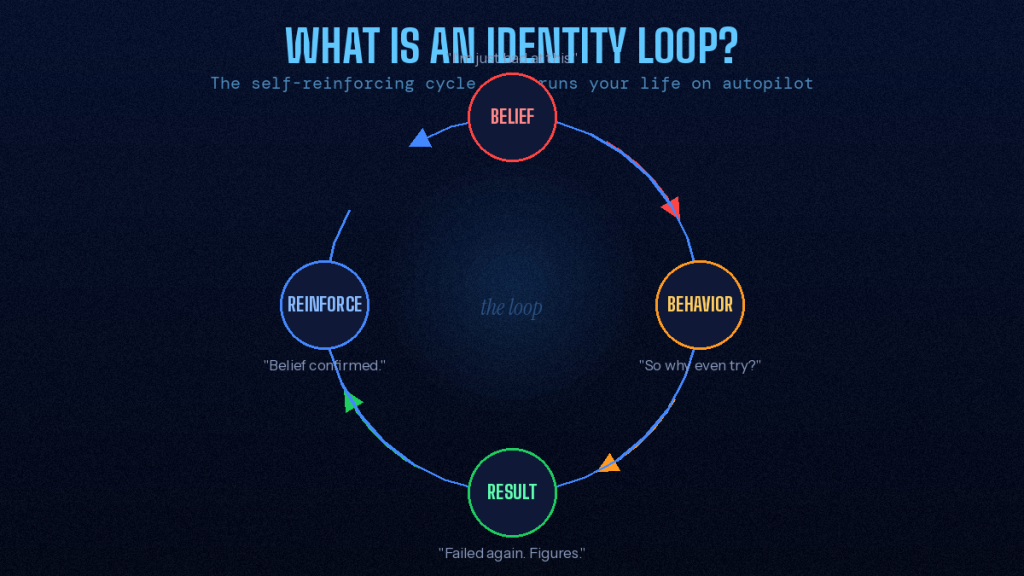
Psychologists call this confirmation bias, but in the context of self-identity, it goes deeper. It becomes what researchers describe as an identity loop. A self-reinforcing cycle where your beliefs shape your behavior, your behavior produces results that confirm the belief, and the belief gets stronger. Round and round it goes.
Think of it like this: if you believe you’re bad with money, you’ll avoid looking at your bank account, make impulsive purchases out of stress, and then point to your overdraft as proof that you’re bad with money. The story writes itself. Literally.
What an Identity Loop Actually Looks and Feels Like
Before you can interrupt an identity loop, you have to recognize one. And the tricky part? They don’t feel like loops. They feel like facts.
Common limiting identity statements:
- “I’m just not the kind of person who exercises consistently.”
- “I’m terrible in social situations.”
- “I’ve always been anxious.”
- “People like me don’t get ahead.”
- “I can’t stick to anything.”
Notice how each one sounds permanent. That’s the hallmark of an identity loop. It’s framed not as a habit or a phase, but as a character trait. When a story becomes your identity, it stops being something you do and becomes something you are. That’s when it really starts to dig in.
Signs you’re stuck in a negative identity loop:
- You use phrases like “I’m just like that” or “that’s how I’ve always been.”
- You feel a strange comfort in your own limitations
- You unconsciously avoid situations where your belief might be challenged
- You feel defensive when someone suggests you could change
- You notice the same pattern repeating across different areas of life
Why Repeated Narratives Become Beliefs (And Why That’s Actually Good News)
Here’s the science bit, and it’s surprisingly hopeful.
Every time you think a thought, your brain fires a set of neurons. When you think that same thought again, those neurons fire together again. Do it enough times, and those neurons start to wire together, forming what neuroscientists call a neural pathway. This is the basis of neuroplasticity, and it’s why habits (including thought habits) become automatic.
The infamous phrase, “neurons that fire together, wire together,” coined by neuropsychologist Donald Hebb in 1949, essentially describes how your identity loop gets paved into your brain like a highway. The more you drive on it, the smoother it gets, the harder it is to take the exit.
This is the good news: neuroplasticity works both ways. The same mechanism that builds limiting loops can build empowering ones. Your brain is not fixed. It’s not finished. It is, right now, capable of forming new pathways at any age.
Dr. Joe Dispenza, whose work in Breaking the Habit of Being Yourself bridges neuroscience and meditation, puts it bluntly: most people spend their lives thinking the same thoughts, making the same choices, and then wondering why nothing changes. The neuroplasticity loop is either working for you or against you; there’s no neutral option.
How to Interrupt Your Identity Loop in Real Time
This is the part everyone wants to skip to. And I get it. But knowing the “what” only works if you understand the “why,” which is hopefully clicking into place now.
How do you actually interrupt an identity loop? Not someday. Today. Right now.
1. Catch the Story as It’s Running
The first step isn’t changing anything. It’s noticing. Most identity loops run on autopilot, completely beneath conscious awareness. Your job is to bring them to the surface.
Start listening for the moment you make a self-defining statement. Not just out loud in your head. “I’m so stupid.” “I can’t do this.” “Of course that happened to me.” When you catch one, mentally flag it: that’s a story.
This is where journaling becomes an incredibly powerful tool. Writing down recurring thoughts externalizes them. It moves them from the fog of feeling into something you can actually look at and question. Research on expressive writing, pioneered by psychologist James Pennebaker, shows that even brief journaling sessions can reduce psychological distress and shift self-perception.
2. Don’t Just Think — Act Differently
Here’s where most people stall: they try to think their way out of an identity loop. They repeat affirmations and visualize. They read motivation quotes at 6 am. And nothing changes.
Why? Because the loop is reinforced through behavior, not just thought. You have to give your brain new evidence. If you believe you’re bad at discipline, you don’t need to convince yourself you’re disciplined. You need to do one disciplined thing and let your brain update its files.
James Clear, author of Atomic Habits, calls this identity-based habit change: instead of setting a goal, you ask, “What would the kind of person I want to be do right now?” Then you do that. Even in the smallest way. Especially in the smallest way.
3. The Reframe-Interrupt-Replace Method
This is a structured technique for real-time loop interruption:
- Catch the automatic story. “I always fail at this.”
- Pause and label it. “That’s an old story. Is it actually true?”
- Insert a more accurate or growth-oriented statement. “I’ve struggled with this before. I’m still figuring it out.”
Notice the replacement isn’t toxic positivity. You’re not saying “I’m amazing at this!” You’re saying something your brain can actually believe, which is what makes it stick.
What’s the Difference Between Interrupting and Breaking a Loop?
Good question, and it matters.
Interrupting is a moment-to-moment act. It’s the pause, the noticing, the micro-choice to not follow the automatic script. It’s essential, but it’s not enough on its own.
Breaking a loop is what happens when you’ve interrupted it enough times and reinforced the alternative enough times, so that the old pathway becomes less traveled. The loop doesn’t vanish. It just stops being the default route.
Think of it like weeds in a garden. Interrupting is pulling one weed. Breaking the loop is planting so many flowers that the weeds run out of light.
This is why consistency matters more than intensity. You don’t need a dramatic transformation moment. You need a thousand small ones.
Quick Answers: Your Identity Loop Questions, Addressed
| Question | Short Answer |
| How long does it take to interrupt and rewire an identity loop? | There’s no fixed timeline, but research on habit formation suggests meaningful neural changes begin within 21–66 days of consistent new behavior. Deep-rooted loops may take longer. |
| Does meditation help interrupt automatic identity responses? | Yes. Meditation builds metacognitive awareness — the ability to observe your own thoughts without merging with them. Even 10 minutes daily strengthens this muscle significantly. |
| Can therapy or coaching accelerate the process? | Absolutely. Cognitive Behavioral Therapy (CBT), Internal Family Systems (IFS), and identity-focused coaching all provide structured frameworks for loop interruption that are significantly faster than solo effort. |
| How do I handle resistance when trying to interrupt my loop? | Expect it. Resistance is the loop protecting itself. Treat it as a signal, not a stop sign. Name it, get curious about it, and take a small action anyway. |
| What common mistakes happen when trying to break identity loops? | Trying to change the thought without changing the behavior. Using affirmations that feel false. Expecting instant results. Giving up during the “awkward middle” phase when the old loop is weakening but the new one isn’t solid yet. |
The “Catch the Story” Exercise: Start Today
Here’s a practical exercise you can do in under five minutes.
- Set a timer for 2 minutes. Sit quietly and just notice what you’re thinking.
- Write down any self-referential thought that comes up — anything that starts with “I am,” “I always,” “I never,” “I can’t.”
- For each one, ask: “When did I decide this was true? What would I need to believe instead for my life to look different?”
- Pick one story and commit to doing one small action today that contradicts it.
That’s it. That’s the beginning. Not a breakthrough — a beginning. The loop started somewhere. And it can stop — or change direction — somewhere too.
Tools & Resources to Go Deeper
If you want structured help with identity loop interruption, here are some of the best resources available right now:
- Breaking the Habit of Being Yourself by Joe Dispenza— Neuroscience + meditation for rewiring self-identity loops.
- Atomic Habits by James Clear — The gold standard for identity-based habit change.
- The Mountain Is You by Brianna Wiest — For self-sabotage patterns rooted in identity.
- Huberman Lab Neuroplasticity Toolkit — Free science-based protocols for focus and loop interruption.
- Insight Timer (Identity Meditation Packs) — Guided meditations specifically for self-identity work.
- Psycho-Cybernetics by Maxwell Maltz — Classic self-image reprogramming, still remarkably relevant.
- The Untethered Soul by Michael A. Singer — Mindfulness-based approach to observing andreleasing inner loops.

Final Thought: You’re Already Running a Program
Here’s the truth that took me a while to sit with: you can’t tell yourself stories. The brain is a narrative machine. It’s what it does. The question is never whether you’re running a program; it’s whether the program is one you chose or one that chose you.
The identity loop you’re stuck in right now? It made sense at some point. It probably kept you safe, or helped you belong, or protected you from disappointment. It’s not stupid. But it might be outdated.
And you, being a professional navigating ambition, relationships, pressure, and the ever-present social media highlight reel, you deserve a narrative that’s actually working for you.
So start there. Catch one story today. Question it. Do one thing that contradicts it.
The loop can be interrupted. It starts with noticing.
Which identity story are you ready to rewrite? Drop it in the comments; naming it out loud is the first interruption.
Affiliate Disclaimer: Some of the links on this website are affiliate links. This means that if you click on a link and make a purchase, I may receive a small commission at no additional cost to you.







wish you best and best
This article is both enjoyable and educational. The site continues
to be surprisingly dependable.
Enjoy every single day