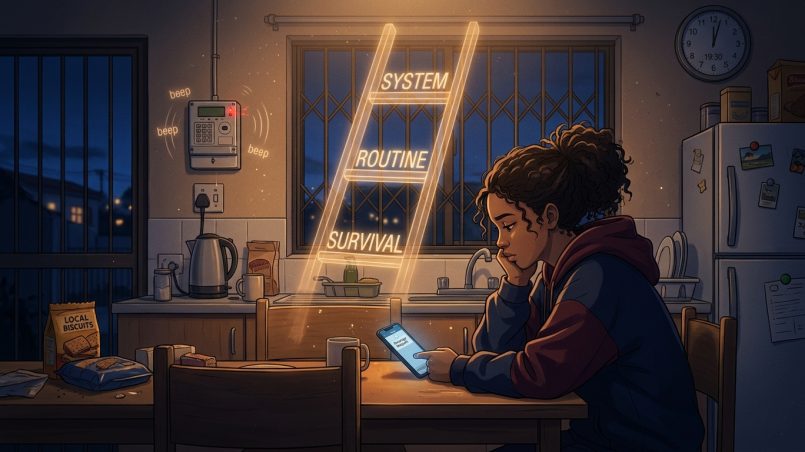
You have been managing the month for years. Nobody ever handed you a system to do it with.
Tuesday, 7 pm. The prepaid meter starts beeping.
You have R85 and nine days to payday.
You buy R20 of electricity. Then R12 of airtime, because the data ran out. Then bread, because the bread ran out. Then a message comes in: transport money, just until Friday.
Nothing on that list is reckless. Every item is real.
By Thursday you have made eleven money decisions. The meter made one. The phone made one. The bread made one. The message made the rest.
I know that Tuesday. I lived it.
Payday arrived and was gone by the same weekend. By the middle of the month, I was borrowing from family or friends just to make it to month-end.
Nobody calls that a system. But it ran every month, on its own rules, and it kept producing the same Tuesday.
So I went looking. I did my own research on the internet. I prayed about it. I attended a workshop called “Paradigm Shift on Finances,” and my eyes opened.
The mindset did not shift overnight. It took time. But slowly I started to see the opportunities that could dig me out of the hole.
I call the way out of it The Three Rungs.
The Three Rungs: Who Decides Where the Money Goes

Phase 1 gave you names for what you inherited. Phase 2 puts your money in motion: the Three Pockets, the Month Map, the Money Talk, and the Earning Chain.
Phase 3 is Building Past the Ceiling. The ceiling is the month you keep hitting no matter what you earn. Week 9 starts with a plain question about every rand you spend: who made that decision, and when?
The answer puts you on one of three rungs.
1. The Survival Rung: The Emergency Decides
The meter beeps, so you buy electricity. The tank is empty, so you fill it. The message arrives, so you send.
The decision gets made at the till, under pressure, with no time to think. Whatever is loudest gets paid first.
This rung is not laziness. It is what a tight month looks like from the inside.
2. The Routine Rung: Your Willpower Decides
You have a budget. You have a plan. Every payday you sit down, work it out, and hold the line.
It works until a bad week. A funeral. A burst geyser. A month with five Fridays. Then you are tired, and the plan depends on you being less tired than you are.
Most people who have outgrown Survival get stuck here. They believe the answer is more discipline. They are rebuilding the plan from scratch every month, and it costs them energy they do not have.
3. The System Rung: A Decision You Made Earlier Decides
On a calm Sunday, you decide where the money goes. You set it up so it moves without you.
When payday lands, the transfers have already happened. When the meter beeps, the money for it is already sitting in its own place. When the message arrives, the answer is a number you set weeks ago.
The decision is made once, when you are calm. Your mood on the 27th does not get a vote.
| Survival | Routine | System | |
| Who decides | The emergency | You, every time | You, once, in advance |
| When it’s decided | At the till, under pressure | At month start, with effort | On a calm Sunday |
| A bad week does | Wrecks the month | Breaks the plan | Gets absorbed by the Reserve |
| Costs you | Money, in small expensive pieces | Energy, every month | A few hours to set up |
| Feels like | Chasing | Gripping | Quiet |
| Builds | Stress | Discipline | Self-trust |
Self-image drives behavior. Behavior creates evidence. A person on the Survival Rung collects evidence that money is something that happens to them. A person on the System Rung collects the opposite every payday, without needing to feel brave.
Why Survival Spending Costs More
Survival spending is expensive. The cost is built into how we buy.
Electricity in R20 pieces. Airtime in R10 pieces. Bread daily, from the spaza, at the spaza price. Every small purchase made in a panic costs more per unit than the same thing bought with a plan. Nobody sees it, because each piece looks small.
Then add the rest of the month.
Stage 4 does not wait for your budget. A funeral does not check your payday. A debit order still hits on the 1st, whether or not your salary has landed. And when the money runs out before the month does, the next door you knock on is a mashonisa, whose interest eats the following month before it starts.
That is how a tight month becomes a loop. Survival spending this month creates the shortfall next month.
Here is how it looks across the lives we serve:
- The floor worker pays for the last week of the month on credit, then pays that credit off in the first week, and starts the month already behind.
- The graduate with the first real salary spends the first week catching up on everything that waited for payday.
- The hustler buys stock in panic because the cash is in hand and pays the supplier’s rushed price.
- The tradesman gets paid in a lump, spends the lump on the loudest bill, and is back at zero before the next job.
- The professional has a good salary, no Reserve, and a card that absorbs every surprise.
Cape Flats, a township and suburb. The names change. The Tuesday does not check your postcode.
And nobody taught you this at home. In a house where the whole month was survived, planning looked like a luxury for other people. Your parents did what survival required. They never had the margin to build a system, so they had nothing to hand down.
The Move: Build the System in One Sunday

Set aside two hours with a pen and your banking app. Do the setup once. After that, the system runs.
- Mark last month’s survival expenses. Go through last month. Circle every payment that felt like an emergency: electricity, transport, airtime, “just until Friday.” Write the rand amount next to each.
- Find the repeats. Anything that happened three or more times is not an emergency. It is a bill that has no name. Write it down as a monthly bill with a number, and put it on your Month Map.
- Route the money on payday. Decide where every rand goes before it lands: your Promises, your Wage, your Reserve, your family ceiling. Set a standing transfer in your banking app for the day after payday so the money moves without you. If you are paid in cash, split it into the envelopes within the hour.
- Give the small things their own place. Put electricity, airtime, and transport into one labelled pot, topped up on payday. When the meter beeps, you spend from the pot, and it does not come out of your groceries.
- Write three if-then rules. One for the family, ask. One for the “special offer.” One for the small emergency. Example: “If someone asks for money, then the answer is the amount already in the family line, or ‘next month.’ Put them on your phone lock screen.
- Book a ten-minute review every Sunday. Fixed day, fixed time. Three questions: Did the transfers happen? Is the Reserve higher than last week, even by R20? How many survival spends did I make?
- Book a repair day. Once a month, pick a Sunday to fix what broke. Adjust a number. Add a bill you missed. Move a date. Do not scrap the system.
If step 1 is hard to look at, that tells you how long the money has been invisible.
The Part Nobody Wants to Hear
Your first system will be wrong.
You will forget a bill. You will set the family line too low or the Wage too high. Month one will break something. That is normal.
Most people read the first break as proof they are not built for this. They scrap the whole thing and go back to Survival. The break is the data. It shows you the number you did not know, which is the whole reason you built a system.
This is the boring season of consistency. Nothing about moving R300 on the 26th looks like progress. But a person who sets a plan on a Sunday and keeps it for a month has just proven something to themselves, and that proof is what reaches past money.
Aim for a system that survives its own mistakes. A perfect one does not exist.
FAQs
What is survival spending?
Survival spending is money spent in response to an emergency or urgent need instead of a plan. Electricity, airtime, transport, and “just until Friday” money are typical examples. It becomes a pattern when the same emergencies repeat every month.
What is the difference between a budget and a money system?
A budget is a plan for the month. A system is the setup that carries the plan out for you: standing transfers, labelled pots, if-then rules, and a weekly review. A budget depends on your energy. A system keeps working when your energy is low.
How do I stop living from payday to payday?
Start by finding out what repeats. Move the repeating costs into your Month Map as named bills, route your money on payday, and build a small Reserve. Even R20 a week starts the shift.
Why do I always run out of money before month end?
Usually because repeating costs are being treated as surprises, so they never get budgeted. Step 2 of The Move shows you which ones they are. Once they have a line, the end of the month stops being a surprise.
How do I build a Reserve when I can barely cover the basics?
Start with an amount small enough to feel almost silly, like R20 or R50 on payday. The amount matters less than the habit of moving it before you spend. Raise it only once it has survived two months.
Do I need a separate bank account for this?
No. Envelopes or tins work on day one. A separate savings pocket or account helps later, because a physical split is harder to spend by accident.
What if my income is irregular or comes in lumps?
Route each lump the day it lands, using fixed percentages for your pockets. Pay yourself the same Wage every week from the pot, so a big week fills the Reserve and a slow week draws from it.
How do I handle family emergencies inside a system?
Give them a place. Your Week 3 family ceiling sits inside your routing, and a small emergency pot covers funerals and hospital bills. When the ask arrives, you answer from the pot instead of from your rent.
What if someone asks for money before I have routed my pay?
Route first. If your payday transfers happen within the hour, nothing unplanned is left to ask for. Your answer is “my family budget is already set for this month.”
How do I stop using a mashonisa?
Do not try to stop in one month. Add the repayment to your Month Map as a named bill, build a small Reserve, and use the Reserve to cut the dependence one payday at a time. The aim is for the next shortfall to be covered by your own money.
How long does it take to set up?
About two hours on a Sunday. The weekly review is ten minutes after that. Most people see the first real change after one full month of routing.
What if my system breaks in the first month?
It will, and that is useful. Use your repair day to fix the one thing that broke. Adjust a number or add a missing bill. Do not scrap the system.
How do I keep to the system when my willpower is low?
You are not using willpower. The transfers move on their own, and the pots are already filled. The system is built so a tired week costs you nothing extra.
Can I use a system if my partner and I share money?
Yes, if you agree on the routing together. Bring the numbers on paper, the way you would for the Ten-Minute Money Talk from Week 7. Two people running on one agreed system fight less than two people running on two moods.
What is the first step if this feels like too much?
Step 1 of The Move. Circle last month’s survival spends. Do not change anything yet. Seeing them is the first edit.
Resources to Build the System
| Resource | What it does for The Move |
| A plain notebook | Steps 1 and 2. Last month’s survival spends, written by hand. |
| Your banking app’s standing transfers | Step 3. Moves the money on payday without you. |
| A labelled pot for electricity, airtime and transport | Step 4. Turns the beeping meter into a planned cost. |
| Your phone lock screen | Step 5. Keeps the three if-then rules in front of you. |
| Your existing stokvel, if you’re in one | Proof that you can keep a routine on a fixed date. Use that same discipline for the Reserve. |
| Free R500 Startup Guide | For when the squeeze is that not enough comes in. Five low-cost business ideas to build income that is yours to route. |
| Skill to Scale (course in the works) | For when the system holds, and you want a hands-on skill to earn more through it. Updates on the WhatsApp channel. |
Build Your System With Us
Your month does not need more discipline. It needs one calm Sunday.

This week, circle last month’s survival spends. Name the repeats. Move the money before you spend it.
Then join the WhatsApp channel, where Week 10 lands next Monday and where we work through these moves together. Link at the top of the page.
Money You Didn’t Learn At Home Series:
- The Money Rules Nobody Taught You
- Payday Is a Mirror, Not a Moment
- The Silent Contract: Black Tax and the Money You Don’t Get to Keep
- Why You Spend Fast, Freeze Up, or Hide It
- Your Hustle Is a Business—Start Treating It Like One
- The Budget Nobody Showed You How to Build
- How to Talk About Money With Family: The Three Silences
- Make Money From a Skill in South Africa: The Earning Chain
- Stop Living Paycheck to Paycheck: Build a Money System—You Are Here