You can work every hour God gives you and still earn the same number.
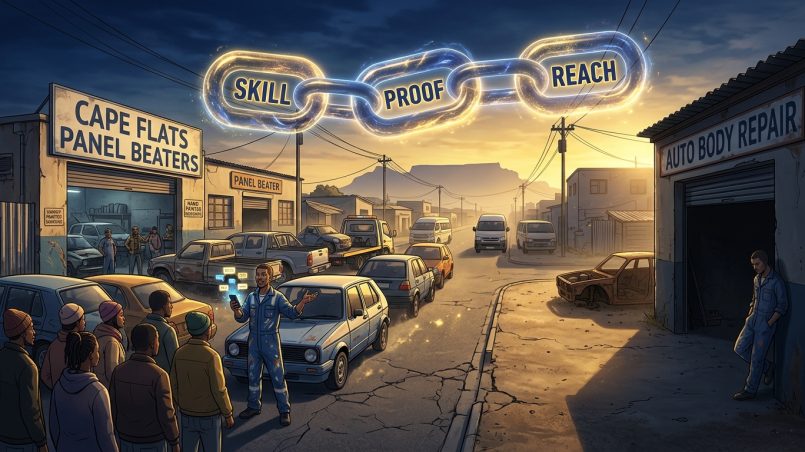
Two panel beaters on the same road. Same tools. Same hours. Same customers walking past.
One is booked three weeks out. The other is phoning round on a Monday morning, asking if anyone has “something small.”
Both put in the hours. Both know the trade.
The gap between them has a name, and it has nothing to do with luck.
I have a friend who is a mechanic. A proper one.
He can listen to an engine and tell you what’s wrong before the bonnet is up.
People bring him cars from all over the area. Taxis, bakkies, the neighbour’s Polo.
He fixes them for whatever the owner hands over. Sometimes it’s a good number. Sometimes it’s “I’ll sort you Friday.”
I asked him once what he charges for a full service. He couldn’t give me a number. He said it depends on who’s asking.
He has never taken a photo of a finished job. His customers are the people who already know him.
So the income stays the same, month after month, from a man who is better at the trade than he was five years ago.
He has the Skill. He’s missing the other two links.
I call the whole thing The Earning Chain.
What Is the Earning Chain?
Phase 2 has covered where the money goes (The Three Pockets), how to plan it (The Month Map), and how to talk about it (The Three Silences).
Week 8 goes to the thing that makes it arrive.
Every rand you earn passes through three links. The weakest link sets your pay.
1. The Skill
The Skill is something you can do that a specific person will pay to have done.
Not a qualification. Not a job title. A result.
The geyser fixed. The fade cut clean. The tax return filed. The inverter installed. The poster designed.
Most people already have one. They just never called it a skill, because it never came with a certificate.
2. The Proof

Proof is what a stranger can see before they trust you.
Before-and-after photos. A finished job on somebody’s wall. A customer’s WhatsApp saying “it’s perfect, thank you.” A name passed from one person to the next.
Self-image drives behaviour, and behaviour creates evidence. Proof is that evidence made visible to other people.
Without it, you charge for hope. With it, you charge for results.
3. The Reach
Reach is how many of the right people know you exist and how easy it is for them to ask.
A WhatsApp Business catalogue. A Google listing with your number on it. A pinned post with three finished jobs.
Reach without Proof gets you looked at once. Proof without Reach keeps you the best-kept secret on the street.
The Weak Chain vs the Built Chain
| Weak Chain | Built Chain | |
| What you sell | Your hours | A result |
| How you price | Whatever the customer offers | A number per job |
| How customers find you | Whoever walks past | A listing, a catalogue, referrals |
| What a good job earns you | A thank-you | The next three jobs |
| What a slow month looks like | Phoning around | A follow-up list |
| Who knows you’re good | Your street | People you’ve never met |
The Rule That Keeps the Chain Weak
In Week 1, you met the Rule: the belief you inherited before you could question it.
This one runs underneath most weak chains: A real skill comes with a certificate. What I do with my hands is just something I do.
That Rule was handed down by people who sacrificed to get you a qualification. They meant well, and in their day it was right.
The Reaction is quiet. You don’t price your work. You don’t photograph it. You wait for someone to notice.
The Receipt is the same income, year after year, from a person who is better at the work than they were three years ago.
Why This Hits Harder in South Africa
Our parents were told a degree was the way out. Many of them paid for it, in sacrifice, in overtime, in doing without.
Then the degree arrived, and the job didn’t. Youth unemployment has been a fact of life for a generation.
Meanwhile, a trade got treated like the thing you do when you couldn’t make it. Welding. Plumbing. Mechanics. Hair. The work people stand in a queue for, and then look down on.
Load-shedding told the truth about that. When the power went, the electrician, the inverter installer and the generator mechanic had a queue. Nobody asked where they went to school.
Then there is Ubuntu and the family rate.
Your cousin needs his laptop fixed. Your aunt needs her forms filled in. A neighbor needs a gate welded “quickly.” You do it for free because family is family.
That’s The Silent Contract from Week 3, billing your skill instead of your salary. The hours are real. The Proof never gets collected because nobody photographs a favor.
Here is how it looks across the lives we serve:
- The floor worker fixes cars after hours for people in the street and never builds a customer list.
- The graduate designs posters for friends for free and wonders why the degree isn’t paying.
- The hairdresser, barber, or tradesman has a chair or a bakkie full every day, and there is no way for a stranger to find them.
- The professional does the neighbors’ tax returns quietly for a box of chocolates.
Cape Flats, township, suburb!. The skill is there. The chain is missing two links.
And nobody showed you the free tools that fix that. They exist. They just never reached the people who needed them most.
The Move: Build Your Three Links in Seven Days

Do this with a notebook and your phone. You don’t need money to start.
- Ask three people what they come to you for. Not what you think you’re good at. What they actually ask you to do. Write all three answers down.
- Write your Skill sentence. “I [do this] for [this person] so that [this result].” One sentence. If it needs two, you haven’t chosen yet.
- Price the result, not the hour. Work out what the job costs you in stock, transport, and data (your Stock Pocket from Week 5), then add your Wage. That’s your number. Write it down and say it out loud once.
- Collect three pieces of Proof. Before-and-after photos of your next three jobs. Ask each customer for one line on WhatsApp. Save all of it in one folder.
- Make it findable. Set up a free WhatsApp Business profile with your Skill sentence, your price range, and your three best photos. Add a free Google Business Profile if people search for your kind of work.
- Put your family rate on paper. Decide what family and friends pay, and write it next to your family ceiling from Week 3. A discount you chose is a price. A discount you couldn’t refuse is a loss.
- Review every Sunday. Ten minutes. One skill, one new piece of Proof, one new person who now knows what you do.
If step 3 makes you nervous, that tells you how long you’ve been guessing.
The Part Nobody Wants to Hear
Narrow beats wide.
The person who does “everything” gets haggled. The person known for one thing gets referred.
Five skills done at an average level earn average money from people who’ll shop around. One skill done well, photographed, and priced earns more from people who ask for you by name.
You can add the second skill later. First, make the first one impossible to overlook.
This is the boring season of consistency again. One photo a job. One Sunday review. One line in a notebook. Nobody claps for it, and it’s the work that builds the income.
Where This Is Going
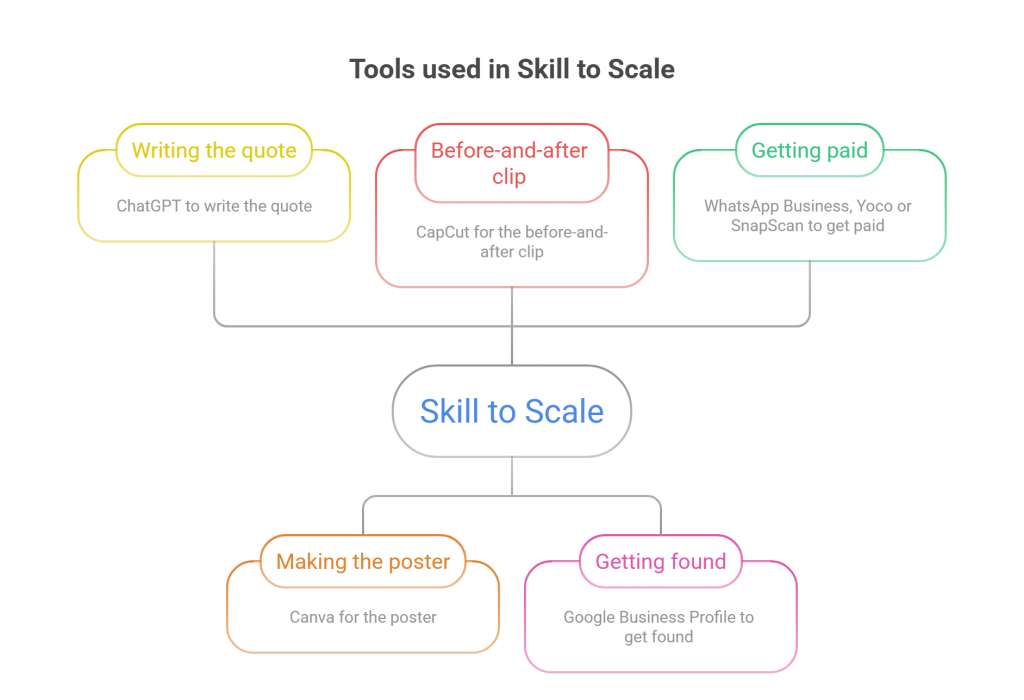
I’m building a course called Skill to Scale for people who already have a hands-on skill and want it to pay properly.
It uses free tools: ChatGPT to write the quote, Canva for the poster, CapCut for the before-and-after clip, Google Business Profile to get found. Then WhatsApp Business, Yoco or SnapScan to get paid.
You don’t need it for The Move. A notebook and a phone are enough to start today.
More on Skill to Scale is coming on the WhatsApp channel.
FAQs
How do I know what my skill is?
Ask three people what they come to you for. The answer is usually something you do so easily that you’ve never counted it as a skill.
Is a skill more important than a degree?
A degree opens some doors. A skill gets you paid while you wait. The two stack, and one doesn’t cancel the other.
Can I make money from a skill without a qualification?
Yes. Customers pay for results they can see. A qualification helps in some trades and is required in others, so check what your field needs before you charge for it.
How do I price my work?
Add up what the job costs you (stock, transport, data), then add your Wage. Price the result, not the hours. Raise it when your diary fills up.
How do I get my first customers without money for ads?
Start with the people who already ask you for help. Do the job well, photograph it, and ask for one line of feedback. Then post it on your WhatsApp Business profile.
What is Proof, and how do I collect it?
Proof is anything a stranger can see that shows you finished a job well. Photos, a customer’s message, and a referral. Collect it at the end of every job, every time.
Do I need a website?
No. A WhatsApp Business profile and a Google Business Profile are free, and most customers will contact you on WhatsApp anyway.
What if my skill is a hobby, not a trade?
Then treat the first paid job as the test. If someone pays and comes back, you have a Skill. If they don’t, you’ve learned what to improve.
How do I stop doing free work for family and friends?
Set a family rate and put it on paper. Tell them the rate before the job, the same way you’d tell a stranger. Link it to your Week 3 ceiling so it doesn’t come out of your rent.
What if I’m not good enough yet?
Charge for the level you’re at and say what that level is. Customers pay for honest work at a fair price, and every paid job is a rep that raises your level.
Can I do this while I have a full-time job?
Yes. Keep the side income in its own pocket from Week 5 so your salary doesn’t pay for it by accident. Work in the evenings or on Saturdays and keep the hours you can sustain.
Which skills are in demand in South Africa?
It depends on your area. Electrical work, plumbing, welding, mechanics, hair and beauty, solar and inverter installs, and design all get steady demand. Check what people near you actually ask for.
Will AI take my skill?
Hands-on skills are the hardest to replace, because the work happens in a house, a yard or a chair. AI tools can write your quote, design your poster and answer your messages, which frees you to do the work.
Do I need to register before I charge for my skill?
You can start earning without it. As you grow, registration and tax rules may apply, so check the current requirements on the SARS and CIPC websites.
How long before I see more income?
Seven days gets you your Skill sentence, your price and your first piece of Proof. Referrals take longer, usually a few weeks of consistent jobs and photos.
Resources to Build Your Three Links
| Resource | What it does for The Move |
| A plain notebook and your phone | Steps 1 to 4. Your Skill sentence, your price, and your Proof folder. |
| WhatsApp Business (free) | Step 5. A catalogue, a profile and quick replies so customers find your price without asking. |
| Google Business Profile (free) | Step 5. Puts your number in front of people searching for your kind of work nearby. |
| Canva and CapCut (free tiers) | Turns your photos into a poster or a before-and-after clip in minutes. |
| Free R500 Startup Guide | For when the squeeze is that not enough comes in. Five low-cost business ideas to build income that is yours to budget. |
| Skill to Scale (coming) | The course for turning a hands-on skill into steady income. Updates on the WhatsApp channel. |
Build Your Chain With Us
Your hands already work. The hours are there.
This week, write your Skill sentence. Just one line. Then take one photo of your next finished job.
Then join the WhatsApp channel, where Week 9 lands next Monday and where we work through these moves together. Link at the top of the page.
Money You Didn’t Learn At Home Series:
- The Money Rules Nobody Taught You
- Payday Is a Mirror, Not a Moment
- The Silent Contract: Black Tax and the Money You Don’t Get to Keep
- Why You Spend Fast, Freeze Up, or Hide It
- Your Hustle Is a Business—Start Treating It Like One
- The Budget Nobody Showed You How to Build
- How to Talk About Money With Family: The Three Silences
- Make Money From a Skill in South Africa: The Earning Chain—You Are Here