You didn’t run out of money on the 17th. You ran out of plans on the 1st.
It’s the 17th. Payday is eight days away. The account is almost empty.
I know that feeling, because I lived it.
I had too much month and too little cash.
Somewhere past the middle of the month the maths stopped working. So I did the thing nobody wants to admit to. I asked friends and family. I kept asking until month’s end.
It was shameful. Every message cost me something other than rands.
Then I cut what I didn’t need. I wrote down what the month actually cost. For the first time I planned my expenses before the money landed, not after it was gone.
That plan was survival.
Maybe you’ve tried a budget once. A spreadsheet in January. A notebook in March. Both died by the second week.
Nobody sat you down and showed you how to build one. Nobody showed me either. Many of our parents ran the month in their heads, with a stokvel, a burial society and a prayer.
They did what they could. They never had a template, and neither did we.
This week is about how to budget in South Africa without borrowing a method built for someone else’s life. I call mine The Month Map.
What Is the Month Map?

Phase 1 gave you names for what you inherited. Week 5 showed you where the money belongs while it moves through your hands.
Week 6 asks where the whole month belongs before it starts.
A budget is a decision you make early so the Reaction doesn’t get to make it late.
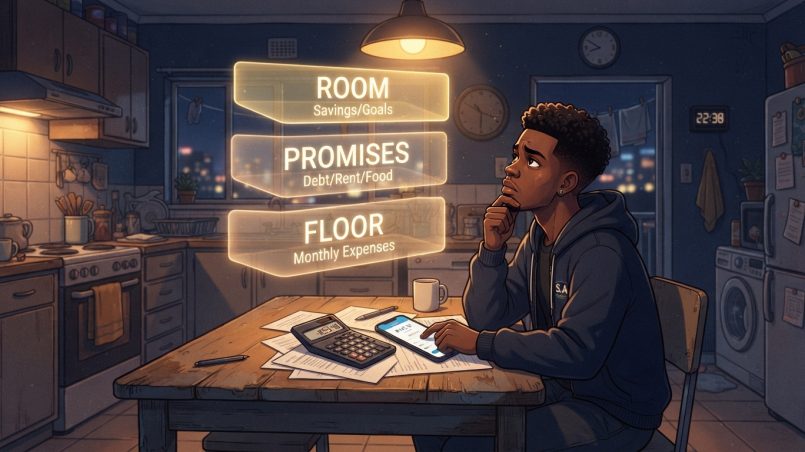
The Month Map has three layers. You fill them in this order every time.
1. The Floor
The Floor is what keeps you standing. Transport to work or school. Food. Rent or bond. Prepaid electricity. Data and airtime. Funeral cover.
Price it from the last three months of real spending, not the version you wish was true.
The Floor gets paid first because when it cracks, everything above it cracks too.
2. The Promises
The Promises are what you’ve committed to or inherited. Your family ceiling from Week 3. The stokvel. The furniture account. The loan repayment. School fees.
If you run a hustle, your Wage from Week 5 is the income line that feeds all of this.
A Promise you never wrote down becomes a Promise you resent. Write every one, with an amount and a date.
3. The Room
The Room is what’s left after the Floor and the Promises.
It has two doors. The Future door: Reserve or savings, even R50. The Now door: spending money with no guilt attached.
The Future door gets filled first. The Now door gets whatever remains, as a number you chose.
Month-End Survival vs The Month Map
| Month-End Survival | The Month Map | |
|---|---|---|
| When it’s decided | At the till, in the moment | Before payday, on paper |
| What you know | “It’s tight” | A number for each layer |
| Who gets paid first | The loudest request | The Floor, then the Promises |
| A surprise bill feels like | A crisis | A withdrawal from the Reserve |
| The 17th looks like | R340 and a calculator you won’t open | A balance you already expected |
| What grows | Stress | Choices |
How Your Reaction Breaks the Budget
Week 4 gave you the Sprint, the Freeze and the Hide. Each one attacks a budget in its own way.
| Your Reaction | How it breaks the Map | What the Map needs |
|---|---|---|
| The Sprint | The Room is empty by the 3rd | Cash for the Now door, in an envelope, drawn at once |
| The Freeze | The Map never gets opened | One ten-minute Sunday on the calendar, no exceptions |
| The Hide | Savings live off the books | The hidden money gets a name, a line in the Map and one witness |
Why This Hits Harder in South Africa
Most budget you’ll find online were built for a salary that lands once, a Floor that stays the same and a family that never calls.
That isn’t the month you live.
Your taxi fare shifts. The power goes out and the food in the freezer goes with it. A funeral takes a month of pay in one weekend. January brings school fees, uniforms and stationery, all due before the January salary has had time to feel like money.
Then there’s the borrowing. “Just until month end” becomes a mashonisa, or a store account, or a cousin whose patience has a limit.
Cash is visible. The budget behind it is not.
Here is how it looks across the people we serve:
- The floor worker paid weekly or fortnightly, running the month in four small pieces and never seeing the whole picture.
- The graduate on a first salary that looks like more money than they’ve ever held, until the debit orders land.
- The hustler whose income swings by the week, with the Wage from Week 5 as the only steady line.
- The professional on a good salary, with debit orders eating the first week, and nobody has looked at them in two years.
Cape Flats, a township and suburb. The salary changes. The month-end scramble does not check your postcode.
And nobody taught you at home. They couldn’t teach what they never had the room to practise.
The Move: Draw Your Month Map

Do this in one sitting, with a pen. It takes about an hour.
- Find your real month. Pull the last three months from your bank app, your SMS alerts and your notebook. Write down what actually left, including the “small” things.
- Write the Floor. List every cost that keeps you standing. Add it up. That number is the first layer.
- Write the Promises. Family ceiling, stokvel, accounts, loan repayments, school fees. Each one gets an amount and a date.
- Find the Room. Income minus the Floor minus the Promises. If it comes out negative, you haven’t failed. You’ve found the real problem, and it’s now small enough to work on.
- Split the Room. Future first: Reserve or savings, even R50. Then the Now door, as one number.
- Put dates on it. Mark when each debit order and each Promise lands. If you’re paid weekly or fortnightly, draw one small Map per pay period.
- Run it for one month before you change it. Review on Sunday, ten minutes. Adjust once at month-end, not in the middle of a bad week.
If step 3 stings, that tells you how long the Promises ran without a name.
The Part Nobody Wants to Hear
The budget that lasts is the one with room for waste in it.
Most first budget are built by a person in a good mood, who gives themselves nothing. By the second week, the real person shows up, blows the plan, and decides budgets don’t work.
Put your leak on paper. Give the Now door a real number. Small enough that it stings a little, big enough that you can breathe.
A budget you can live inside beats a perfect one you abandon on the 9th.
This reaches past money. Keeping a plan you wrote for yourself is self-trust, built one month at a time.
FAQs
What is a budget?
A budget is a plan for your money, written before the month starts. It tells every rand where to go so you aren’t deciding at the till.
How do I budget on a small salary?
Start with the Floor and price it honestly. A small salary makes the Map more useful, because every rand has less room to disappear without being noticed.
What do I do if my Floor costs more than I earn?
Write it down anyway. The gap is your real problem, and now you can work on it: reduce one Floor cost, renegotiate one Promise, or raise the income side.
How do I budget when my income changes every month?
Build the Map from your lowest recent month. Anything above it goes to the Reserve first. A slow month then gets paid from a cushion, not from your groceries.
Does the 50/30/20 rule work in South Africa?
It’s a starting point, not a rule. For many households the Floor alone takes more than half of income, so use the Month Map’s three layers and let your own numbers set the split.
How much should I save every month?
There is no universal number. Start with an amount you can keep paying in a bad month, even R50, and raise it only when the Reserve has a cushion.
Do I need a budgeting app?
No. A notebook and a pen work on day one. An app helps later, once the habit is steady and you want your transactions tracked for you.
How do I budget if I’m paid weekly or fortnightly?
Draw one small Map per pay period. Put the monthly Floor items, like rent, on the paydays closest to their due dates.
How do I fit family support into my budget?
It goes in the Promises layer as a number, using the ceiling you set in Week 3. When a request comes, the answer is the number you already decided.
What do I do when an emergency blows the budget?
Pull it from the Reserve. If the Reserve is empty, make the emergency the first reason to start one, even at R20 a week.
Should I pay off debt or save first?
Build a small Reserve first, so the next surprise doesn’t become new debt. Then put extra money towards the debt with the highest interest. If it’s too heavy to carry, a debt counsellor registered with the National Credit Regulator can help. This is general information, not personal financial advice.
How often should I review my budget?
Ten minutes every Sunday to check, and one proper adjustment at month-end. Constant mid-month edits teach you the plan doesn’t count.
What if my partner and I disagree about the budget?
Bring the written Floor and Promises to the conversation. Numbers on paper turn an argument about feelings into a planning conversation.
Does this work if I’m a student on a bursary or allowance?
Yes. The Map works at any income, including a monthly allowance of a few hundred rand. The Floor is just smaller.
How long before a budget feels normal?
Expect the first month to feel awkward and the third to feel routine. You’re building a habit, and habits stop feeling forced through repetition.
Resources to Draw Your Month Map
| Resource | What it does for The Move |
|---|---|
| A plain notebook | Steps 1 to 4 on paper, where the numbers are harder to ignore than on a phone. |
| Your bank app’s spending view and SMS alerts | Gives you the three months of real spending for Step 1. |
| Envelopes or a separate savings pocket | Gives the Future and Now doors a physical home, so the Room can’t be spent by accident. |
| Your existing stokvel, if you’re in one | Proof that you already keep a structured monthly commitment. Use the same discipline for the Reserve. |
| Free R500 Startup Guide | For when the Room comes out negative because not enough comes in. Five low-cost business ideas to build income that is yours to budget. |
Draw Your Map With Us
You can’t follow a plan you’ve never written.
This week, draw your Month Map. One page. Three layers: Floor, Promises, Room.

Then join the WhatsApp channel, where Week 7 lands next Monday and where we work through these moves together. Link at the top of the page.
Money You Didn’t Learn At Home Series:
- The Money Rules Nobody Taught You
- Payday Is a Mirror, Not a Moment
- The Silent Contract: Black Tax and the Money You Don’t Get to Keep
- Why You Spend Fast, Freeze Up, or Hide It
- Your Hustle Is a Business—Start Treating It Like One
- The Budget Nobody Showed You How to Build—You Are Here